
Redo built its reputation on one of the more disruptive ideas in post-purchase: returns software that costs merchants nothing. With notable brands like Cozy Earth, Liquid Death, and TaylorMade in its roster, the model has clearly resonated. Onward operates on a similar funding principle: both platforms are powered by a customer funded model, with no SaaS fee passed to the merchant.
So if the business model is roughly the same, what's actually different?
Quite a bit. The real distinction isn't how the software gets funded. It's what you get once it is. Redo started as a returns tool and has expanded aggressively across a wide range of adjacent categories. Onward was built from the ground up as an integrated post-purchase platform, designed to cover every stage of the customer journey after checkout, with depth in each area rather than breadth across many.
That difference shows up in coverage, customer intelligence, loyalty mechanics, claims handling, and billing transparency. It also shows up in one structural constraint that's worth understanding before you commit: to access Redo's returns software at no cost, you have to offer free returns to your customers. With Onward, you don't. Your return policy stays your decision.
Platform Depth vs. Category Breadth
Both Onward and Redo offer returns management, order protection, order tracking, and order editing. On paper, the feature list looks similar. In practice, the experience is not.
Redo has expanded into 12+ product categories in under 18 months, adding email marketing, OMS, AI support, checkout optimization, and more. The ambition is real, and for merchants who want a single vendor across the broadest possible surface area, that scope is appealing. But when a platform moves that quickly across that many categories, it's worth asking how deep any single product actually goes. Most of those categories already have best-of-breed incumbents with years of dedicated development behind them. The rate of expansion matters as much as the feature list itself when you're evaluating a long-term platform partner.
Onward's platform is intentionally focused on the post-purchase journey, and every product is built with that scope in mind: order protection, returns management, order tracking, order editing, and the customer intelligence layer that runs across all of them. That focus is what makes it possible to go deeper on things like dynamic customer treatment, expanded claim types, CashBack rewards, and sub-hour claims resolution, capabilities that require dedicated investment in the post-purchase experience specifically.
Feature Comparison
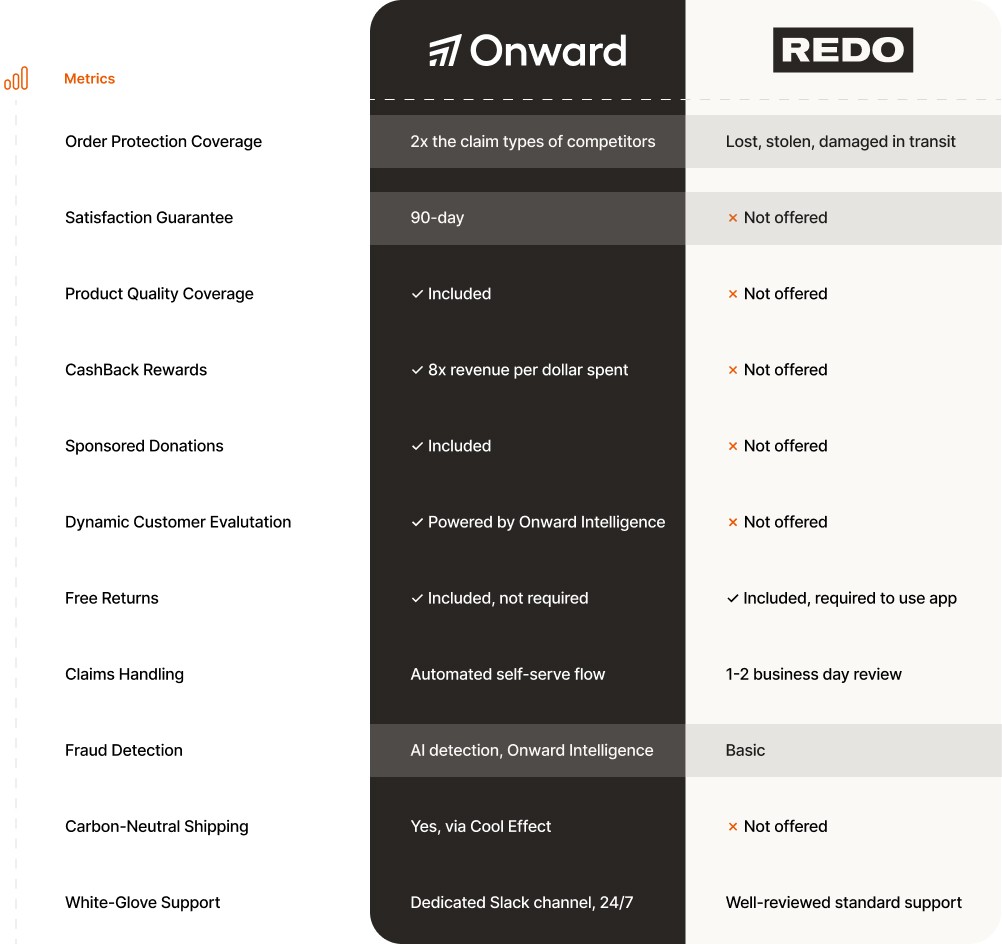
A side-by-side comparison makes the distinction clear. While both platforms share a zero-SaaS foundation, the capabilities merchants actually rely on vary significantly across coverage scope, claims handling speed, customer intelligence, and satisfaction guarantee. The table below breaks down where each platform stands on the dimensions that matter most.
What Redo's Model Actually Involves
Redo's core offer is straightforward: opt your customers into a checkout widget that bundles free return shipping with order protection for roughly $1 to $3 per order. Customers who add coverage get free returns. Redo collects the premium and uses it to fund the returns cost and power the software. Merchants pay no SaaS fee.
Free returns are part of the deal
To access Redo's returns software at no cost, merchants must enable the consumer-paid widget and offer free returns as part of that coverage. For some brands, that trade-off is manageable. For brands in categories with high return propensity, or for merchants who have built their return policy deliberately around margin, it's a structural constraint worth modeling before you commit. Free returns tend to increase return rates. More returns mean more product coming back, more restocking labor, more refunds processed, and more revenue cycling backward through the business.
Coverage stops at the doorstep
Redo's order protection covers lost, stolen, and damaged packages in transit. There is no satisfaction guarantee, no product quality coverage, no recourse for wrong items received or missing items from an order. Claims are reviewed within one to two business days, meaning customers with legitimate issues wait while the merchant absorbs the reputational cost of a slow resolution.
Billing has layers
Redo gives merchants a choice: keep 100% of shipping protection revenue and handle all claims yourself, or work through their partner to cover claims but share the premium. The "100% of shipping protection revenue" offer sounds compelling, but it omits that Redo retains the returns coverage portion of the consumer premium entirely. You're receiving the portion attributed to shipping protection, while Redo keeps what was allocated to returns. Merchants have found this structure difficult to model and benchmark against alternatives.
No loyalty mechanics
Redo's model delivers value to customers when something goes wrong. On orders where nothing goes wrong, which is most orders, there is no customer-facing benefit beyond the coverage itself. There are no CashBack rewards, no repeat purchase incentives, and no post-purchase loyalty mechanics.
No customer intelligence
Every customer on Redo receives the same experience regardless of their lifetime value, purchase history, or return behavior. There is no behavioral scoring, no dynamic treatment, and no mechanism to reward your best customers differently from your most problematic ones.
What Onward Does Differently
Onward approaches post-purchase as an integrated platform with one guiding principle: give merchants full control over their customer experience and return economics, not just access to software.
No free returns requirement
Merchants can offer free returns, paid returns, exchange-only returns, or any hybrid structure they choose. That flexibility is available regardless of whether customers are enrolled in Checkout+. Your return policy stays your decision, not the platform's.
Returns management is included at zero SaaS cost
You get exchange-first logic to retain more revenue, configurable return windows, automated approval rules, and full policy flexibility, all without a monthly software fee.
Coverage that goes beyond the shipment
Onward covers 2x the claim types of competitors, including wrong items received, missing items, and product quality issues. A 90-day satisfaction guarantee extends coverage to the product experience itself, not just what happened between the warehouse and the front door. For apparel brands dealing with fit, consumables brands dealing with quality perception, and home goods brands dealing with expectation mismatches, that coverage gap is material.
CashBack rewards
Checkout+ includes store credit rewards that customers receive on every protected order, whether or not anything goes wrong. Onward sponsors a portion of each CashBack credit, and every dollar spent on CashBack generates 8x in revenue. The offer at checkout becomes something that delivers tangible value on every order, not just a contingency product that most customers never use.
Automated claims resolution
When a customer files a claim with Onward, the merchant doesn't have to staff it. Onward's platform guides customers through a self-serve claims flow with built-in AI fraud monitoring, targeting resolution in under an hour. For brands that have absorbed claims volume into their CX team's workload, this is a meaningful operational shift.
Billing transparency
Onward's model is straightforward: you know exactly what you keep, what Onward's fee is, and how the math works on every order. There is no split-model billing, no revenue attribution complexity, and no portion of the premium silently retained by the platform.
Sponsored donations.
Onward enables merchants to offer customers the option to direct a portion of their Checkout+ fee to a cause their brand supports, adding meaningful alignment between the purchase experience and the brand's values.
White-glove merchant support
Each Onward merchant gets a dedicated Slack channel with 24/7 access to the team. Questions are answered by people who know your account, your products, and your history, not a ticketing queue.
Carbon-neutral shipping
Onward partners with Cool Effect, a certified 501(c)3 nonprofit, to neutralize the carbon emissions from every protected shipment and handles all setup and costs.
Onward Intelligence
This is the capability that has no equivalent in Redo's platform. Onward Intelligence is a real-time scoring layer built into every post-purchase touchpoint, analyzing 40+ customer behaviors including spend history, lifetime value, and return patterns to determine what experience each customer should receive.
Your best customers get faster claim approvals, seamless resolutions, and double CashBack credits. Problem customers get appropriate friction that discourages abuse without creating a scene. The result is a platform that rewards profitable behavior and protects your margins from the customers who erode them, without applying blanket policies that punish good customers for the actions of bad ones.
This is the Prime playbook. Amazon has used customer-tier intelligence for years to reward loyal buyers and protect against abuse. Until now, building something comparable required custom data infrastructure that was out of reach for most DTC brands. Onward brings that capability to every merchant on the platform, built in, with zero configuration required.
Questions to Ask When Evaluating
Regardless of which platform you're considering, these questions will help clarify what you're actually getting:
Does the platform treat every customer the same, or does it have the intelligence to differentiate your best customers from your worst?
Does protection create value on every order, or only when something goes wrong?
Does coverage extend to product satisfaction and quality issues, or only to what happens during transit?
Are you required to offer free returns to your customers in order to access returns management software?
How are claims handled, and how fast? Does your team absorb that work or does the platform automate it?
What is the complete fee picture, including any usage-based charges for add-on products?
Is the billing model fully transparent? Do you know exactly what portion of the consumer premium flows to your business versus to the platform?
The Bottom Line
Redo has built a genuinely impressive platform and solved a real problem for thousands of merchants. The zero-SaaS returns model disrupted an established category, and its continued expansion across email, OMS, support, and checkout reflects serious product ambition.
Both Onward and Redo are funded through customer opt-ins at checkout. Both offer post-purchase software at no SaaS cost to merchants. What differs is the depth of the platform and what it actually delivers for your customers and your business.
Redo expanded broadly. Onward went deep. That shows up in coverage that extends beyond the shipment, CashBack rewards that drive repeat purchases on every order, Onward Intelligence that treats each customer as an individual, automated claims resolution that keeps your CX team out of the claims queue, and billing that is fully transparent from day one.
If your return economics are a priority, the free returns requirement is a structural consideration worth modeling carefully. But even setting that aside, Onward delivers dimensions of post-purchase value that Redo's platform simply doesn't offer. Customer intelligence, loyalty mechanics, expanded coverage, and operational depth are not features Redo has on its roadmap. They are the foundation Onward was built on.
See the difference for yourself. Schedule a demo to learn how Onward delivers more value at every stage of the post-purchase journey.
Categories