Onward vs. AfterShip: Customer LTV Platform or Post-Purchase Toolset?

Matt Kritzer
Updated September 15, 2026

AfterShip is one of the largest post-purchase software companies in ecommerce. It integrates with 1,300-plus carriers, serves thousands of brands, and sells a module for nearly every operational surface after checkout: tracking, returns, shipping labels, warranty, protection, reviews, referrals, email, SMS, and product recommendations.
On a feature checklist, the overlap with Onward looks substantial. Both cover branded order tracking. Both handle returns. Both offer shipping protection. Both talk about post-purchase as a revenue moment rather than a cost center.
The difference is what each platform is architected to produce. AfterShip sells post-purchase operations: a suite of tools that make the logistics of the post-purchase experience run well, priced as software your brand pays for every month. Onward is a customer lifetime value platform: a single system that generates revenue and repeat purchase behavior on every order, funded by the value it creates rather than by a SaaS line item.
That is not a difference in feature count. It is a difference in what shows up on the P&L.
The Core Difference
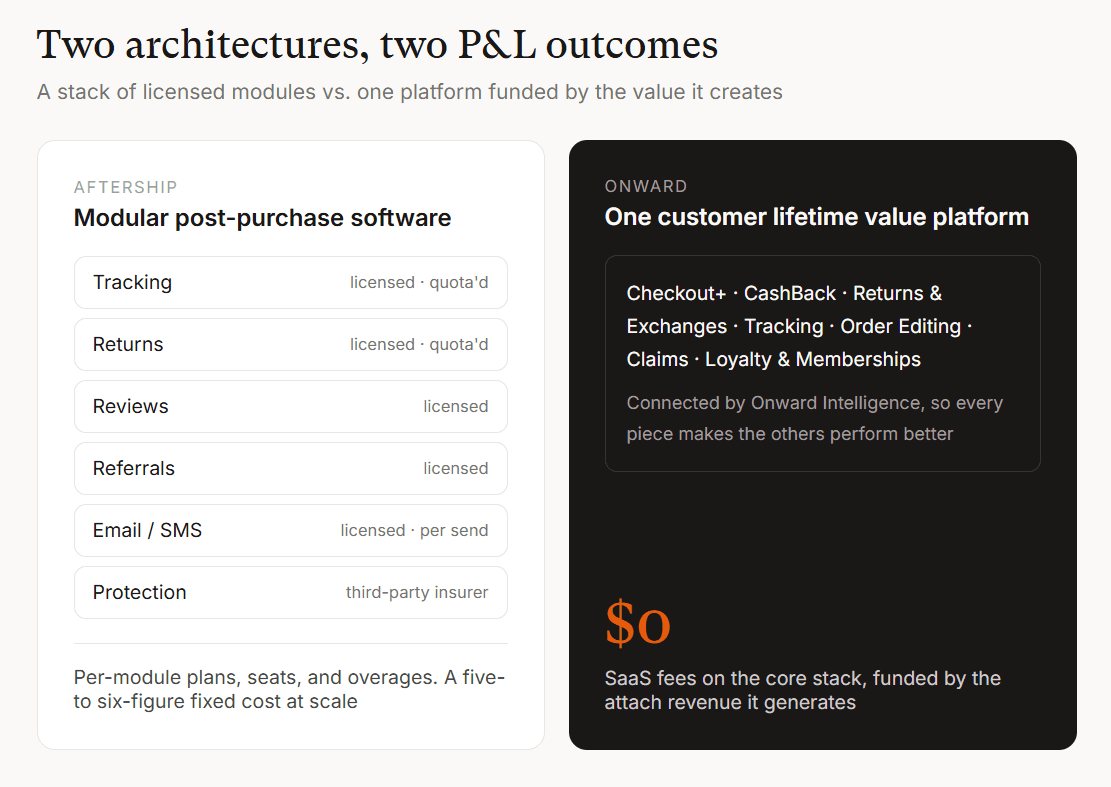
AfterShip's model is modular software. You license Tracking. You license Returns. Reviews are a separate product. Referrals are another. Protection is bolted on, managed by a third-party service. Each module carries its own plan tier, its own usage quota, and its own overage rate. The suite is broad, and each piece is competent. The economics are those of a SaaS stack: costs scale with your volume, and the value is operational efficiency.
Onward started from a different question: what should the post-purchase experience do for a brand when nothing goes wrong? The answer became Checkout+, an order upgrade that bundles order protection, CashBack rewards, a 90-day satisfaction guarantee, coverage across twice the claim types of standard competitors, optional free returns, carbon-neutral shipping, and sponsored charitable donations into a single opt-in.
Behind Checkout+ sits Onward Intelligence, a real-time agentic scoring system analyzing 40-plus customer behaviors. Alongside it sits the full platform: Returns and Exchanges, Branded Order Tracking, Order Editing, Claims Management, and, following the acquisition of Inveterate, Loyalty and Paid Membership programs. All at zero SaaS fees.
AfterShip makes post-purchase operations work. Onward makes post-purchase generate lifetime value. Both are legitimate strategies. They produce very different numbers.
What AfterShip Delivers
Carrier coverage is a real strength. With 1,300-plus carrier integrations, AfterShip tracks shipments across a wide range of markets and regional logistics providers, which matters for brands with complex international routing. The tracking product itself is mature and configurable, and AfterShip credits it with a 65% reduction in WISMO tickets.
The returns product is capable: automated labels, eligibility rules, exchange flows, store credit incentives, warranty management, and pre-built ERP and WMS integrations at the Premium tier.
Breadth is the other thing AfterShip sells. Tracking, returns, warranty, reviews, referrals, email, SMS, and marketplace feeds all come from one vendor with one login. For a brand that wants a single procurement relationship across a lot of surfaces, that has genuine appeal.
The question is whether breadth and integration are the same thing. In this case, they are not. Each module is licensed, quota'd, and operated as its own product, with its own dashboard and its own contract line. Nothing in the suite is designed to make the other pieces perform better.
And every one of those modules is an operations tool. None of them generate revenue on every order. There is no CashBack mechanism, no customer-level intelligence layer, and no loyalty or paid membership structure anywhere in the lineup.
What Onward's Platform Delivers
Checkout+ and CashBack Rewards
Checkout+ bundles order protection, CashBack credits, a 90-day satisfaction guarantee, optional free returns, carbon-neutral shipping, and sponsored donations into a single opt-in. Customers see genuine value at the point of purchase, not just a safety net for unlikely scenarios.
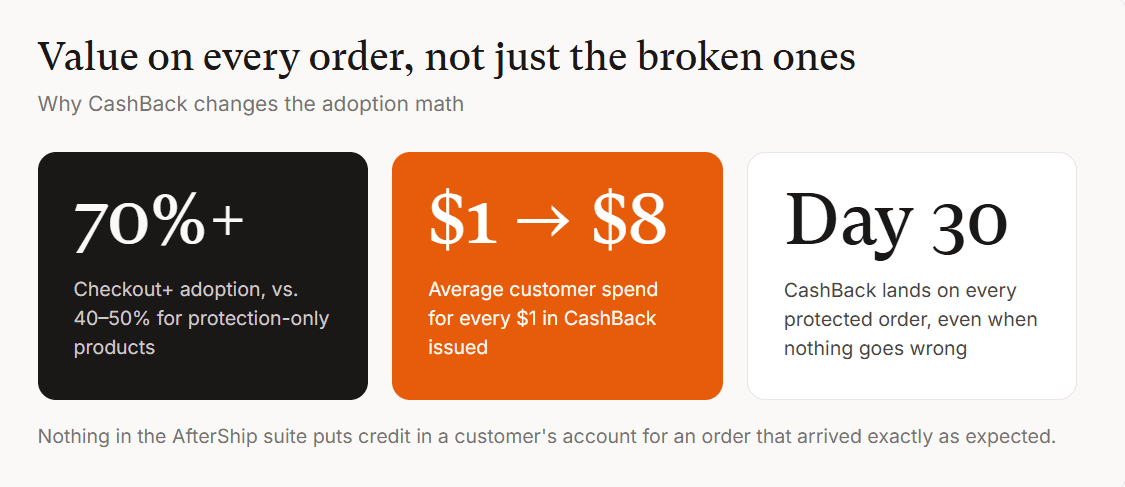
This directly drives adoption. Protection products that only pay out when something goes wrong give customers limited incentive to opt in on repeat purchases. Checkout+ delivers value on every order. Adoption rates land at 70% and above, compared to 40 to 50% for protection-only products.
CashBack credits are issued 30 days after purchase on every protected order, regardless of whether anything goes wrong. Onward sponsors a portion. For every $1 in CashBack issued, customers spend $8 on average.
AfterShip has store credit incentives inside its Returns product and a separate Referral and Affiliate app, but neither is a reward issued on every order. There is no mechanism in the AfterShip suite that puts credit in a customer's account for a purchase that shipped and arrived exactly as expected.
Onward Intelligence
Onward Intelligence is the connective tissue across the platform: a real-time scoring system analyzing spend history, lifetime value, return patterns, and 40-plus other signals. Trusted customers get faster approvals, automatic credits for shipping delays, and double CashBack. Customers exhibiting abusive patterns get appropriate friction that protects margins.
AfterShip offers analytics and fraud prevention rules at the Premium returns tier, and reporting dashboards across its products. Those are aggregate reporting and rule-based automation. They tell you what happened across your order base and let you write conditional logic. They do not score an individual customer in real time and change what that customer is offered.
The distinction matters for CX leaders because Onward Intelligence is the layer that lets a CX team demonstrate impact in dollars, not just satisfaction scores.
Claims Resolution
This is the sharpest structural difference between the two platforms.
AfterShip Protection covers three perils: loss in transit, damage, and porch piracy. It is powered by InsureShield and adjusted by UPS Capital Insurance Agency, so claims run through the insurer, not through AfterShip. According to AfterShip's documentation, approved claims are paid by check directly to the merchant, who is then responsible for facilitating payment to the customer. AfterShip reports that 95% of accurate and complete claims are paid, most within a week. Coverage is capped at $10,000 per order, carries a 90-day filing window, requires a US business entity, and is governed by the insurance policy's terms and exclusions.
That model works, but it introduces an insurer between your customer and their resolution, and it puts the merchant in the middle of the money movement.
Onward covers lost, stolen, damaged, and return-to-sender, plus wrong items shipped, missing items, post-delivery damage, product quality issues (including taste guarantees for consumables and satisfaction guarantees on apparel), and chargeback reimbursement. That is roughly twice the claim types. Resolution targets under one hour through an automated self-serve flow, handled in-house, with fraud detection powered by the same intelligence layer that scores customers.
The difference a customer experiences: a week and a check versus an hour and a resolution.

One Platform at Zero SaaS Fees
Onward's platform includes Checkout+, Returns and Exchanges (with no free returns requirement), Branded Order Tracking, Order Editing, and Claims Management. Zero monthly SaaS fees, across all of it.
AfterShip's protection module also carries no monthly fee. The rest of the suite is licensed software, and the published plan tiers are not the number that matters. Those tiers are built for brands doing a few thousand shipments a year. Every standard plan carries an annual usage quota with per-unit overages beyond it, seats are billed per member per month, and the multi-product bundle discount applies to the first year only. Any brand operating at real volume blows through the standard quotas and lands in a custom Enterprise contract, where pricing is quoted, negotiated, and renewed annually.
That is where the cost conversation actually happens, and the numbers are not nominal. The Commerce Group runs five brands and roughly 400,000 orders a year on Shopify. Before moving to Onward, they were paying about $60,000 annually for two modules: roughly $50,000 for order tracking and $12,000 for returns. That is the enterprise reality of a modular post-purchase stack, and it does not include protection, reviews, email, SMS, referrals, or any of the marketing products sold alongside it.
There is also a cash-flow mechanic worth understanding on the protection side. AfterShip charges the merchant's connected credit card for the protection and Return Care fees shoppers pay at checkout, then distributes the amounts and reconciles claim reimbursements back the following month, applying a 3% transaction fee on positive balances. Return Care is billed per order on top of that.
Onward has none of these line items. No plan tiers, no shipment quotas, no return quotas, no per-seat pricing, no bundle discount that expires after twelve months.
Loyalty and Paid Memberships
The acquisition of Inveterate extends Onward into loyalty programs, paid memberships, spend-based tiers, and VIP programs, all powered by Cashback rather than discounts alone.
CashBack rewards from Checkout+ and loyalty balances from membership programs work as a unified system, giving merchants a single platform spanning from the checkout moment through repeat purchase and long-term LTV growth.
AfterShip does not sell a loyalty or paid membership product. The closest adjacent offerings are the Referral and Affiliate app and store credit incentives configured inside Returns. Neither builds a tiered membership program or a recurring revenue relationship with your best customers.
Feature Comparison
What the Stack Actually Costs
The pricing comparison is worth making concrete, because "both have a free protection product" obscures the real difference.
A brand assembling AfterShip's post-purchase stack licenses Tracking and Returns at minimum, adds seats for the CX team, and exceeds the standard annual quotas as volume grows. Marketing modules, SMS sends, and Return Care stack on top. At scale, that is a five- or six-figure annual contract that shows up as a fixed cost every year and gets renegotiated every renewal.
The same brand on Onward licenses nothing. Checkout+, Returns, Tracking, Order Editing, Claims, and Loyalty carry no subscription. The platform is funded by the attach revenue Checkout+ generates, which means the post-purchase program is a contributor to gross margin rather than a subtraction from it.
That flips the internal conversation. Instead of justifying a growing software line item at renewal, the post-purchase program is defended by the revenue and repeat purchase it produces.
Which Platform Is Right for You?
Choose Onward if you want: Post-purchase measured in LTV and repeat purchase rather than ticket deflection. CashBack rewards driving 70%-plus adoption and an 8x return per dollar issued. Real-time customer scoring through Onward Intelligence. Twice the claim coverage, including product quality and chargebacks. Claims managed end-to-end by one team and resolved in under an hour. A consolidated platform with no SaaS fees on the core post-purchase stack, no usage quotas, and no overages.
Consider AfterShip if you need: Broad carrier coverage for complex international or multi-carrier logistics. A single vendor for both post-purchase operations and marketing channels including email, SMS, reviews, referrals, and marketplace feeds. Deep tracking-page configurability as a primary requirement. You are comfortable with a modular SaaS cost structure and already have rewards and loyalty handled elsewhere in your stack.
Questions to Ask When Evaluating
Does the platform create value when nothing goes wrong? This is the fundamental adoption driver. Programs that only pay out on claims have a structural ceiling on opt-in rates, and operational tooling produces no customer-facing value at all on a normal order.
Who actually handles the claim? A platform that runs claims with its own team controls the timeline, the tone, and the fraud call. A platform that hands claims to an outside vendor controls none of it, and your CX team inherits the wait.
Is the platform integrated, or just bundled? A suite of separately licensed modules under one logo is not the same as a system where each component makes the others perform better. Ask what one product does for another.
What is the total number of claim types covered? Lost, damaged, and stolen is the baseline. Coverage for wrong items, missing items, product quality, and chargebacks represents materially broader protection.
Is there a customer intelligence layer, or just rules and dashboards? Aggregate analytics tell you what happened. Real-time scoring changes what an individual customer is offered based on what they are worth.
What does the stack cost at three times your current volume? Per-module plans with annual quotas and per-unit overages scale differently than a platform with no subscription at all. Model it at your growth case, not today's.
Does the platform extend into loyalty and repeat purchase, or stop at the delivery? Post-purchase that ends when the package arrives leaves the LTV question unanswered.
The Bottom Line
AfterShip has assembled the widest set of post-purchase modules in ecommerce. The carrier network is deep, the tracking product is mature, and the returns product is capable. For brands whose post-purchase requirement is logistical, AfterShip covers it, and covers a lot of adjacent marketing surface too. What it does not do is make those pieces work on each other.
Onward is solving a different problem. Checkout+ as a true order upgrade, CashBack driving repeat purchase, Onward Intelligence personalizing by customer value, claims managed by one team and resolved in under an hour, and loyalty and memberships through Inveterate. One system, built against one objective, with no SaaS fees on the core stack. The result is a post-purchase experience that generates value on every order, not just the ones with problems and not just for the operations team.
If your goal is to run post-purchase operations well, AfterShip is a capable suite. If your goal is to build the system that drives customer lifetime value from checkout through loyalty and repeat purchase, Onward is the platform built for that outcome.
Schedule a demo to see how Onward delivers measurable financial impact across the entire post-purchase experience.
Frequently Asked Questions
What is the difference between Onward and AfterShip?
AfterShip is a modular post-purchase software suite covering tracking, returns, shipping, warranty, and a set of marketing products, each licensed separately with its own plan tiers and usage quotas. Onward is a customer lifetime value platform that combines Checkout+, protection, returns, tracking, order editing, claims, and loyalty into a single integrated system, with no SaaS fees on the core post-purchase stack, funded by the attach revenue it generates rather than by subscription.
Does AfterShip offer CashBack or loyalty rewards?
No. AfterShip offers store credit incentives inside its Returns product and sells a separate Referral and Affiliate app, but it does not issue rewards on every order and does not offer loyalty tiers or paid memberships. Onward issues CashBack on every protected order 30 days after purchase regardless of whether a claim is filed, driving an 8x return per dollar issued, and offers loyalty and paid membership programs through Inveterate.
Who handles claims for AfterShip Protection?
Not AfterShip. Protection claims are handed to a third party for review and approval, and the resolution routes back through the merchant before reaching the customer, a process that runs in days. Onward manages the entire program in-house: one team owns coverage, claim approval, fraud review, and customer communication, with a target resolution under one hour.
Which platform covers more claim types?
Onward covers roughly twice as many. AfterShip Protection covers loss, damage, and porch piracy theft. Onward covers those plus return-to-sender, wrong items, missing items, post-delivery damage, product quality issues, 90-day satisfaction guarantees, and chargeback reimbursement.
How much does AfterShip cost compared to Onward?
AfterShip's protection module carries no monthly fee, but the rest of the suite is subscription software licensed by module, with annual usage quotas, per-unit overages beyond them, per-seat pricing, and a bundle discount that applies only to the first year. Published plan tiers are sized for low-volume stores; brands at real scale are quoted custom Enterprise contracts. For perspective, The Commerce Group was paying roughly $60,000 a year for order tracking and returns alone before switching. Onward charges no SaaS fees across its entire platform, with no quotas, overages, or seat pricing.
Which platform has real-time customer scoring?
Onward, through Onward Intelligence: a real-time agentic scoring system analyzing 40-plus customer behaviors to personalize post-purchase experiences by individual value. Trusted customers receive faster approvals, automatic delay credits, and double CashBack; abusive patterns receive appropriate friction. AfterShip provides aggregate analytics and rule-based fraud prevention at its Premium returns tier, but does not score individual customers in real time.
Does AfterShip have better carrier coverage than Onward?
AfterShip's 1,300-plus carrier integrations are broad, and for brands with complex international or regional-carrier logistics that reach is useful. The tradeoff is that carrier coverage is a tracking capability, not an LTV capability, and it is licensed as a paid module with annual shipment quotas. Brands regularly move from AfterShip to Onward without giving up the tracking experience their customers see.
Categories