WISMO is a symptom, not a category
“Where is my order?" (WISMO) is often treated as a ticket type to be deflected, routing it to a bot, dropping a tracking link into the shipping confirmation, and training the support team to respond inside an hour. That framing has held for years, and it has cost brands real money the entire time.
WISMO is not just a support ticket category. It's also a signal that your post-purchase experience is not keeping customers within your property when their attention to your brand is highest. They opened the shipping confirmation, clicked the tracking link, and landed on a UPS or FedEx page that has nothing to do with you. They didn't ask "where is my order?" because your support team was slow. They asked because the experience you built sent them somewhere else, and that somewhere else didn't tell them what they needed to know.
Brands evaluating their post-purchase stack should reframe the question. The goal is not to reduce WISMO tickets. The goal is to redesign the post-purchase window so the question becomes far less necessary, and so the moments when customers do engage with shipping information happen on a property you control.
What WISMO is costing you
The visible cost of WISMO is well understood. Roughly 30% of support tickets at the average DTC brand are shipping-related. Every one of them carries a fully loaded support cost, and during peak season the volume spikes hard enough to require contract staffing or overtime that wasn't in the budget.
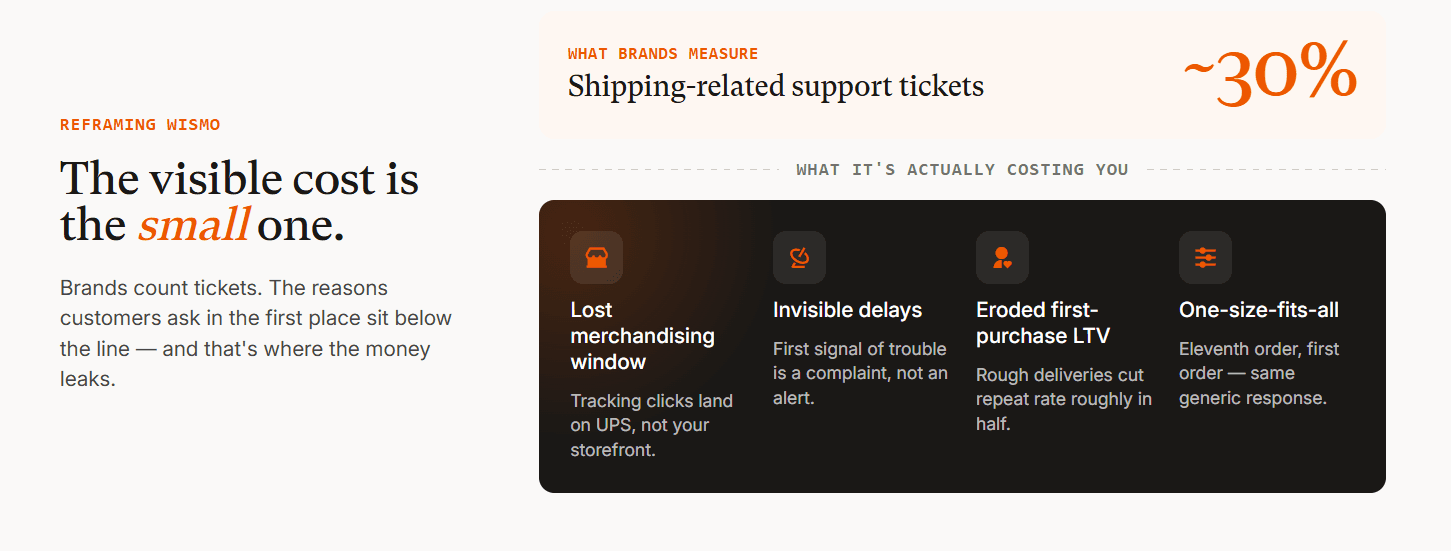
The visible costs are well understood. The hidden costs are larger:
Lost merchandising window. Every customer who clicks a tracking link and lands on UPS or FedEx is a customer your brand briefly lost during the highest-intent moment of the post-purchase journey.
Invisible delays. Packages stuck in transit show up as tickets, not as alerts, so the first signal you get is a frustrated customer rather than a system flag.
Eroded first-purchase LTV. First-time buyers who experience shipping issues repeat at roughly half the rate of customers with smooth deliveries.
One-size-fits-all treatment. A customer with eleven orders gets the same generic delay experience as someone placing their first order.
What needs to change in your current setup
The standard solution is some combination of the following, and none of them solve the actual problem:
A tracking link in the shipping email. Still sends the customer to UPS.com.
A chatbot trained on shipping questions. Still waits for the customer to ask.
A stand-alone tracking app. Shows tracking and nothing else. Doesn't help with returns, claims, or knowing who the customer is.
Each of these manages the symptom instead of fixing the cause. To actually reduce WISMO, three things have to change at the same time:
Tracking has to live on your own website. When a customer clicks "track my order," they should land on your site instead of UPS.com or FedEx.com. Same delivery information, but inside your brand, where you can show them more products and give them reasons to come back.
Customers should hear from you automatically when something happens. Instead of waiting for them to ask, send updates the moment a delivery event occurs. Onward feeds every shipping event (shipped, out for delivery, delivered, delayed) plus CashBack updates directly into Klaviyo, so you can set up automatic emails and texts that fire on each one with no engineering work needed.
Tracking, returns, and claims should all live in the same place. When a customer does have a question or a problem, sending them across three different URLs and three different pages is what creates support tickets in the first place. One page that handles everything removes the "where do I go for this?" problem entirely.
Onward Intelligence is the difference maker
Branded tracking and automatic Klaviyo emails are must-haves for any modern post-purchase setup. What separates a full post-purchase platform from a tracking app is the ability to actually use those delivery signals to treat customers differently based on who they are. That's what Onward Intelligence does.
The same scoring system that analyzes customer behavior across 40+ post-purchase signals sits on top of tracking data and drives proactive responses weighted by the value of the customer.
What this enables:
Proactive outreach on delays. When a tracking signal flags a delay or exception, the system reaches out to the customer before they file a ticket.
Different responses for different customers. A high-value repeat customer gets a premium response (an upgrade, expedited replacement, priority support). A first-time buyer who looks risky gets a measured response that doesn't waste money on a relationship that hasn't been earned yet.
CashBack as a way to make things right. Your best customers can be made whole with credit they can immediately see and use, rather than a one-off discount that lives nowhere.
No support agent needs to notice. Scoring, tracking signals, and Klaviyo emails do the work automatically.
This is the breakthrough. WISMO has historically been a one-size-fits-all problem because the underlying tools have no sense of who anyone is. Once they do, the response can match the relationship, and the time after the sale starts paying for itself.
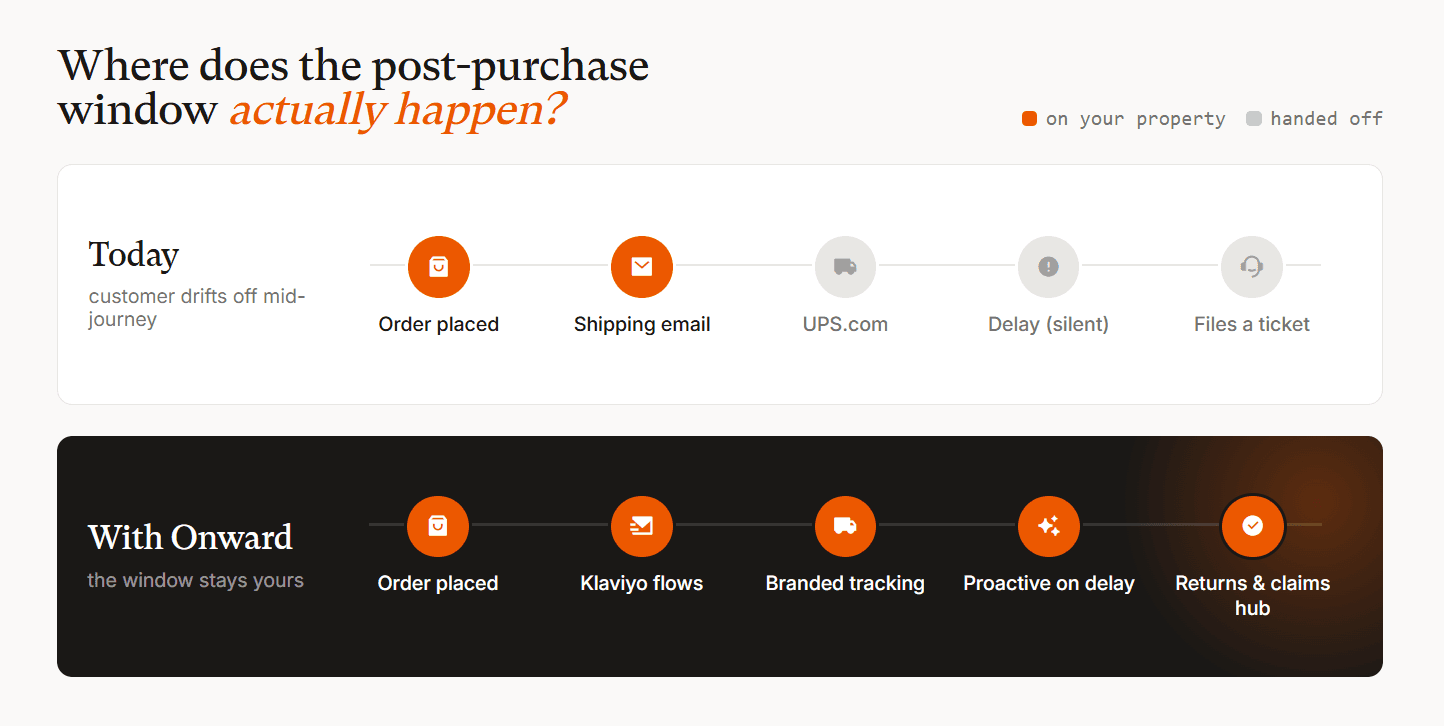
What this looks like in practice
A redesigned post-purchase journey, end to end:
Order placed. Shipping confirmation goes out with a tracking link pointing to your domain.
In transit. Klaviyo fires an "order shipped" flow with complementary product recommendations.
Delay detected. The system catches the carrier delay before the customer does. Klaviyo fires a proactive notification, with accommodation calibrated to the customer's score.
Customer checks status. They land on the Onward Hub: a branded page showing current delivery status, relevant products, and (if needed) a single path to file a claim or start a return.
Package arrives. A "delivered" flow fires with usage tips, reorder suggestions, or a review request.
If something goes wrong. The customer is already in the hub. One place, one experience.
Net result: WISMO tickets drop because the reasons to file them have been removed. The tickets that remain route through the same hub the customer is already using, and CX time gets reallocated to higher-leverage work.
The platform decision underneath
Tracking is one of those product categories where the point-solution market has trained buyers to think small. There are tracking apps that just do tracking. There are returns apps that just do returns. There are claims tools that just do claims. Each of them charges a monthly SaaS fee, and stitching them together creates exactly the fragmented customer experience that WISMO tickets are a symptom of.
The platform decision is the more interesting one. If tracking, returns, claims, CashBack, and customer scoring all live in the same system, the experience can be designed end-to-end rather than assembled. The tracking page can be a hub because it has access to everything the customer might need. Klaviyo flows can include CashBack data because it's flowing through the same platform. Proactive accommodation can be intelligent because the customer scoring sits underneath all of it.
For DTC brands, this is the framing that matters. WISMO isn't a tracking problem. It's a post-purchase platform problem. The brands that solve it are the ones that stop treating each piece as a separate purchase and start treating the post-purchase window as the high-leverage surface it actually is.
Stop chasing WISMO tickets. Start owning the post-purchase window.
See how Onward Track turns delivery updates, claims, returns, and proactive comms into a single experience your customers actually use. Schedule a demo.
Categories