
Corso is a credible Shopify post-purchase platform with real operational strength, particularly in claims handling and customer service. In a brief comparison with Onward, the two companies are roughly the same size, target similar merchants, and offer overlapping capabilities. On a feature checklist, they look almost the same.
But that surface comparison is exactly what costs merchants money. The two platforms are built on fundamentally different philosophies, and the difference shows up in the metrics that actually drive post-purchase ROI.
Corso is a resolution platform that handles problems well. Onward is a loyalty platform that also resolves problems. That distinction sounds subtle, but it shapes everything from attach rates to customer lifetime value to how a CX team can demonstrate impact in dollars.
This comparison walks through what each platform delivers, where Onward separates, where Corso has legitimate strengths, and the questions a merchant should ask when evaluating either one.
The Core Difference
Corso bundles shipping protection, returns and exchanges, warranty registration, tracking, order editing, and carbon offsets into a unified platform fronted by a US-based concierge team. Their pitch is built around resolution: when something goes wrong with a delivery, return, or warranty claim, Corso's team handles it on the merchant's behalf. By their own reporting, they hit 97% CSAT, sub-1-hour first response, and 68%+ protection attach rates across roughly 1,000 active merchants.
Onward built Checkout+ around a different question. Instead of asking how to resolve incidents efficiently, Onward asked how the post-purchase moment could create value on every order, not just the ones with problems. The answer became CashBack rewards, real-time customer scoring through Onward Intelligence, product issue coverage built directly into the order upgrade, and a managed claims operation funded by the same model. Attach rates land in the 70%+ range because customers actively want the upgrade rather than treating it as a safety net they hope they never use.
The remainder of this comparison goes through what each platform actually delivers and what the difference produces downstream.
What Corso's Platform Delivers
Corso has built a genuinely strong product around incident resolution. Their concierge model is well-marketed and operationally proven. Customers file a claim, a US-based specialist responds in under an hour, and the issue gets resolved end-to-end without the merchant's CX team in the loop. Corso reports a 97% customer satisfaction score and a 99% claim approval rate on their public-facing materials. That's a real capability, and it earns the long-tenured customer relationships they showcase in case studies with brands like True Classic, Caraway, and SheFit.
Their platform also covers the other core post-purchase workflows: returns and exchanges, branded order tracking, order editing, carbon offset participation, and a dedicated warranty registration product where customers can register a product after purchase and file a claim against it later. Pricing is performance-based with no fixed fees and no contracts, funded as a percentage of the revenue Corso helps generate.
The structural gap to flag, respectfully, is what's missing from this model. Corso doesn't offer CashBack or any equivalent loyalty mechanism, so customer value depends entirely on something going wrong. The AI built into the platform handles workflow automation, analytics, and registration capture, but it doesn't score individual customers or personalize the experience based on customer value. And while Corso's warranty registration tool is a real product, it operates as a separate workflow that customers have to opt into and engage with. None of that makes Corso a weak platform. It makes them a platform built around a narrower definition of what post-purchase should do.
What Onward's Checkout+ Delivers
Onward took the same core categories (protection, returns, tracking, order editing) and built them on top of a different foundation. Five capabilities organize how Checkout+ delivers value.
Onward Intelligence
Onward Intelligence is the connective tissue across the platform. It's a real-time agentic scoring system that analyzes customer behavior across every post-purchase touchpoint and personalizes the experience based on profile, history, and value. Great customers get the red carpet: faster refunds, automatic credits for shipping delays before they ask, double CashBack, seamless claim approvals. Customers who try to abuse policies get appropriate friction that protects margins without creating a public scene.
Corso's AI is operational tooling. It auto-finalizes routine claims, surfaces analytics, and helps customers register products via photo capture. Useful capabilities, but a different category of investment than a customer-level personalization layer. For CX leaders, this distinction matters because Onward Intelligence is the layer that finally lets a CX team demonstrate impact in dollars rather than satisfaction scores. Every interaction is governed by intelligence that ties customer treatment to customer profitability.
CashBack Rewards and Creating Customer Loyalty
When customers add Checkout+, they receive store credit rewards that drive repeat purchases. Unused protection effectively converts to ongoing loyalty value, so customers feel they're getting tangible benefits whether or not anything goes wrong with delivery. Onward provides the cashback to the customer 30 days after purchase via a unique promo code, with Onward sponsoring half of the cashback to keep the model profitable for the merchant. The credit works like a rolling balance that gets deducted from or added to with future activity.
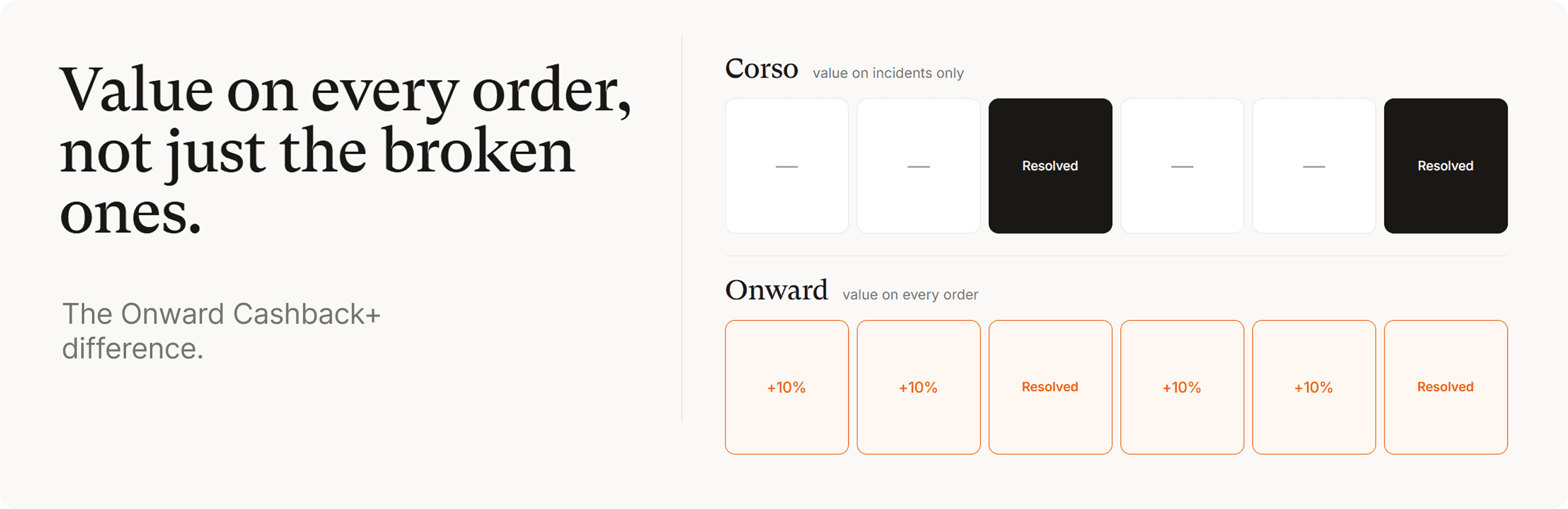
Corso has nothing comparable. This is the single biggest gap in the Corso offering and the one that most directly affects merchant outcomes. Higher attach rates show up because customers actively want the upgrade. LTV lift shows up because the loyalty mechanism creates a structural incentive to come back. Repeat purchase rates improve because every Checkout+ customer is essentially a member of an embedded loyalty program. None of that is available in a resolution-only model.
Product Issue Coverage Built Into the Order Upgrade
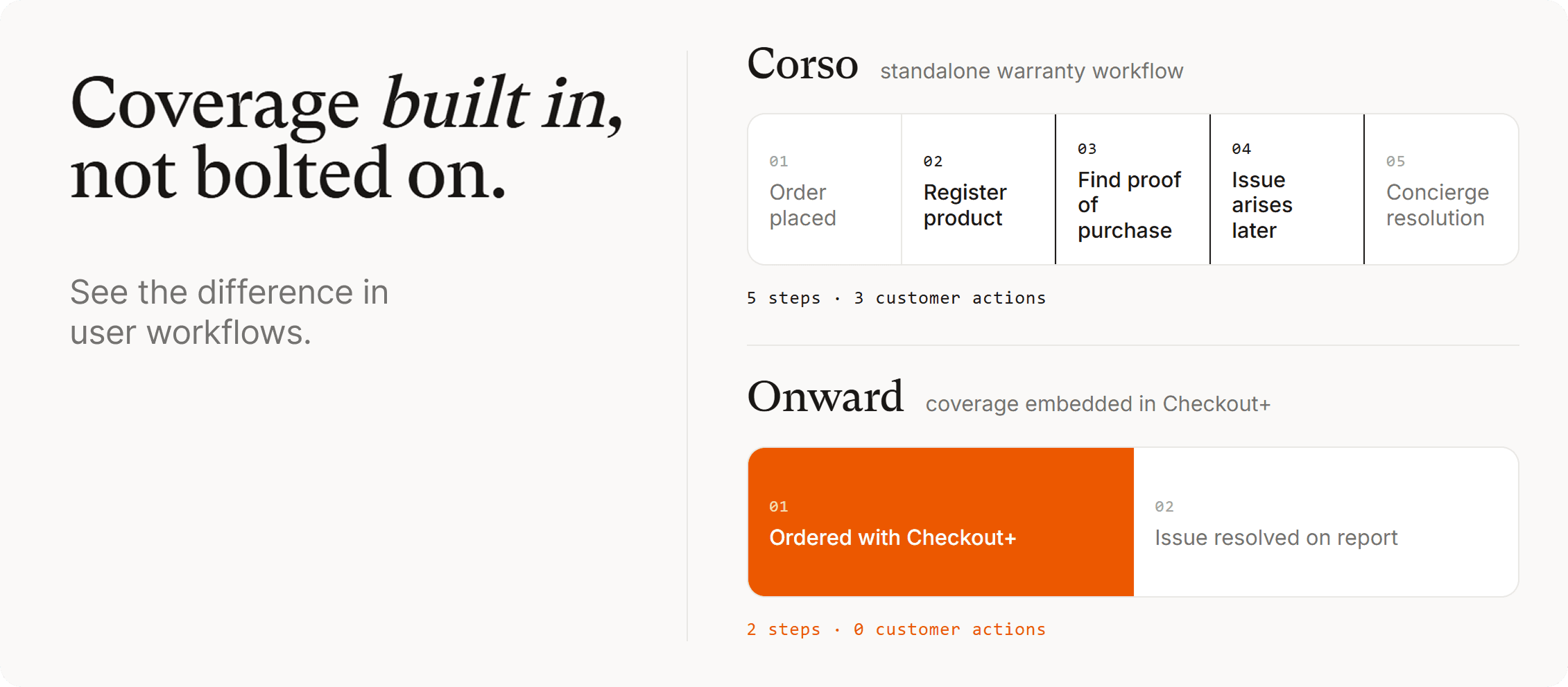
Standard shipping protection covers lost, stolen, or damaged packages. Onward goes further by covering product-related issues as part of Checkout+. That includes taste guarantees for consumables, satisfaction guarantees on apparel, and 90-day extended coverage on soft and durable goods. The customer is covered automatically by virtue of opting into the upgrade. There's no separate registration step, no warranty claim form, no parallel workflow.
This is where the warranty conversation gets reframed. Corso has a real warranty management product, and it's more developed than what Onward offers as a standalone feature. But the practical comparison isn't "Corso has warranties and Onward doesn't." It's that Corso treats warranty as a separate workflow most customers never engage with, while Onward bakes the equivalent coverage into the order upgrade itself. For verticals like consumables, food and beverage, supplements, and subscription products, where customer satisfaction depends on product quality as much as delivery, the embedded coverage model produces a meaningfully better customer experience.
Fully Managed Claims with Integrated Fraud Detection
Both platforms handle claims well. Both have responsive, US-based teams. Both report strong customer satisfaction on claim resolution. This isn't a section where Onward needs to overstate the difference.
Where Onward separates is the integration of fraud detection into the same intelligence layer that scores customers. Decisions on whether to approve, investigate, or deny a claim are informed by real-time customer scoring, not just manual review or rule-based automation. That means legitimate claims from good customers get approved faster, and abusive patterns get flagged before they cost the merchant money. Onward also provides each merchant with a shared Slack channel for 24/7 support, which several customers reference as the difference between feeling like a vendor relationship and feeling like an extension of their team.
No SaaS Fees and Aligned Economics
Onward's entire post-purchase platform operates without monthly software fees. Returns management, order tracking, order editing, and claims handling all come included at zero SaaS cost. Corso also operates a no-fixed-fee model funded by performance, so this is parity on the headline.
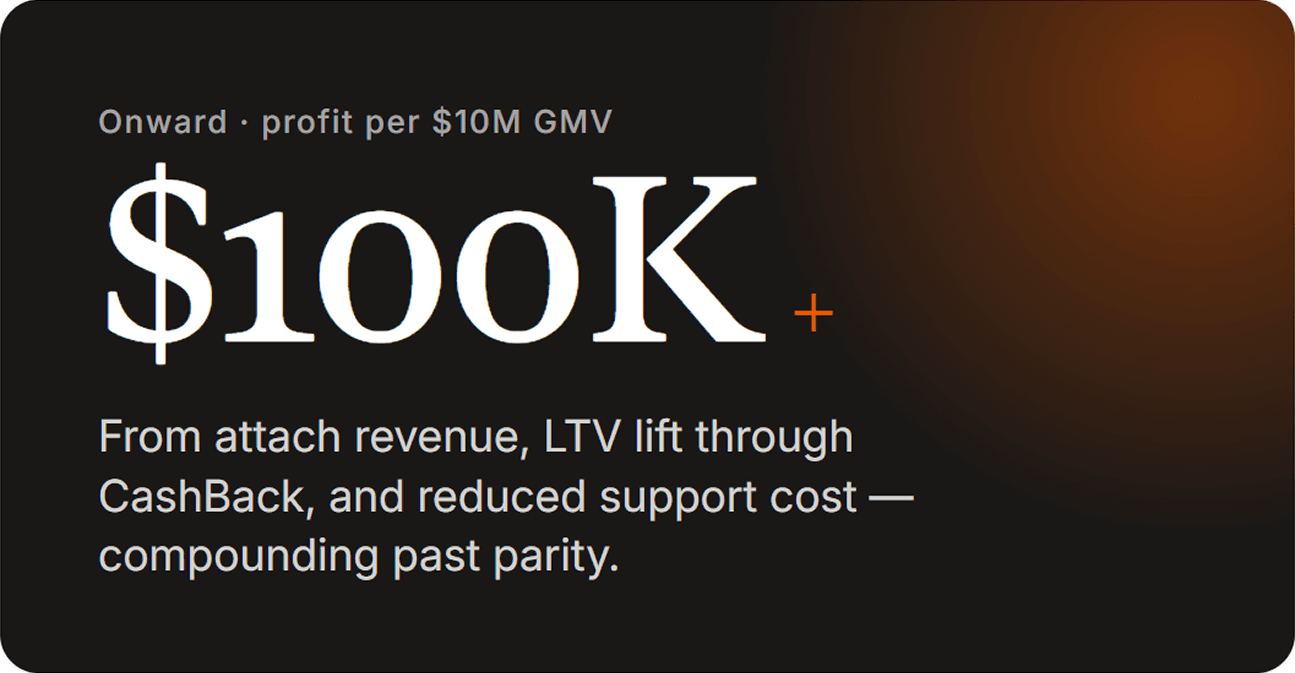
The economic discussion gets more interesting one layer down. Corso runs aggressive rev shares with merchants on protection revenue, which can make their economic pitch look attractive on per-attach math. Onward's model directs some of that economic value back to the customer through CashBack. The result is a slightly different per-attach number paired with a system that drives total profit through LTV lift and repeat purchase. For every $10M in GMV, Onward typically delivers $100K+ in annual profit through the combined effect of attach revenue, LTV lift, and reduced support costs. The right metric to compare is total profit impact, not per-attach revenue capture.
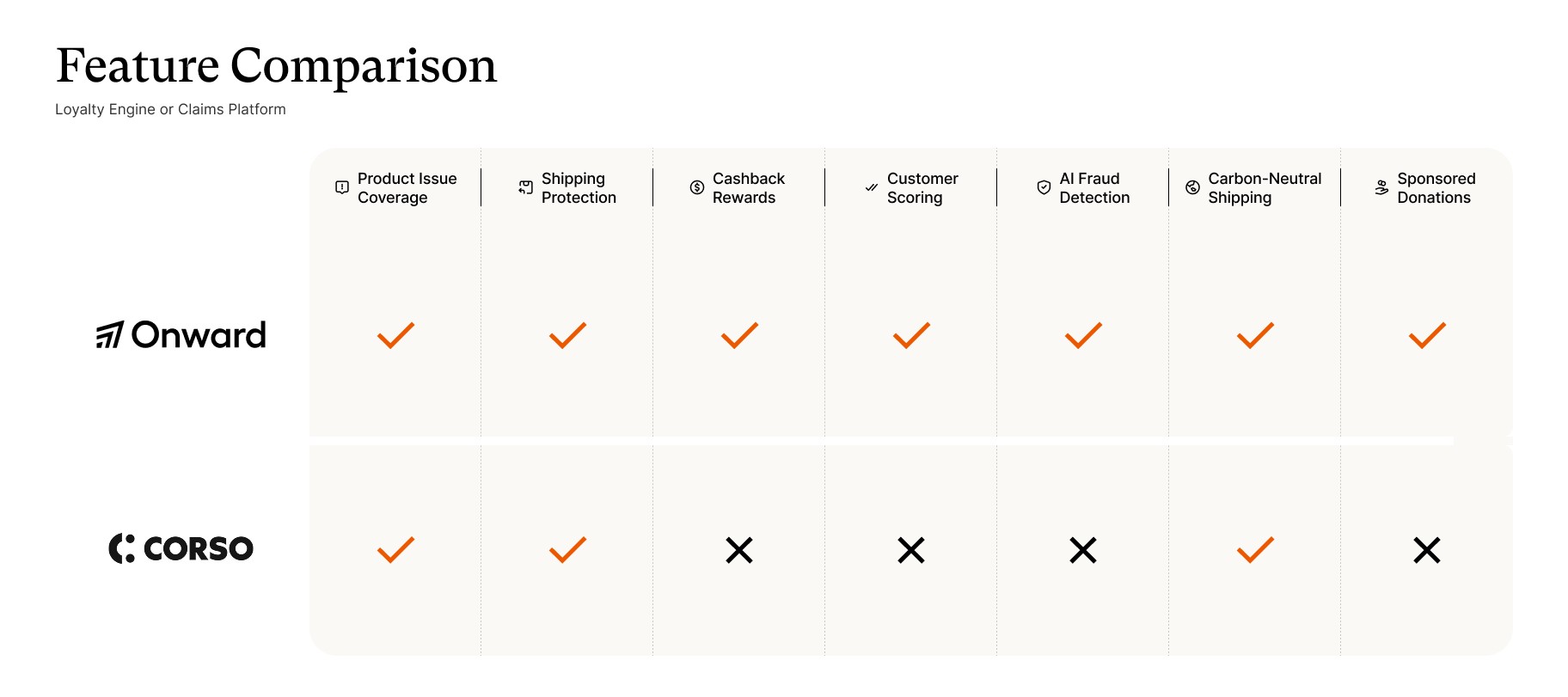
Feature Comparison
The table below summarizes the key differences between the two platforms.
Which Platform Is Right for You?
The right choice depends on what you're optimizing for. Both platforms are credible. They serve different definitions of what post-purchase should do.
Choose Onward if you want:
Merchants who get the most from Onward want maximum financial impact from post-purchase, not just incident protection. They want real-time customer-level personalization through Onward Intelligence. They value CashBack rewards as a tool for driving attach rates and repeat purchase. They want product issue coverage built directly into the order upgrade rather than handled through a separate warranty workflow. And they want a fully managed claims experience with integrated fraud detection, all without monthly software fees.
Maximum financial impact from post-purchase, measured in LTV and repeat purchase
Real-time customer scoring and personalization through Onward Intelligence
CashBack rewards that drive attach rates and loyalty
Product quality coverage embedded in the order upgrade
Fully managed claims with integrated fraud detection
Consider Corso if you need:
Corso makes sense for merchants whose primary post-purchase need is dedicated warranty registration and claims management for SKUs where standalone warranty workflows matter, typically long-life durable goods with formal warranty programs. If a customer-level personalization layer and an embedded loyalty mechanism aren't on your priority list, Corso's resolution model can serve well.
Standalone warranty registration as a primary requirement
Resolution-focused post-purchase without a loyalty mechanism
Questions to Ask When Evaluating
Whether you're evaluating Onward, Corso, or other platforms, these questions will help clarify what you're actually getting:
Does the platform create value for customers when nothing goes wrong with their order, or only when there's an incident?
Is there a real-time customer scoring layer that personalizes the experience by customer value, or is automation rule-based?
Are product quality issues and satisfaction guarantees covered automatically, or do customers need to register products and file separate claims?
Does the platform measurably impact repeat purchase rate and LTV, or only protect revenue on incidents?
Are claims handled fully by the vendor with integrated fraud detection, or does my team stay involved in claim decisions?
What is the total economic impact on profit, accounting for both protection economics and downstream loyalty effects?
The Bottom Line
Corso has built a strong resolution platform with a great team. Their concierge model is well-marketed, their customer service metrics are real, and their warranty registration product is more developed than Onward offers as a standalone feature. For merchants whose post-purchase strategy is "protect revenue when shipping breaks," Corso is a reasonable choice.
Onward built something structurally different. The combination of Onward Intelligence, CashBack, and product issue coverage embedded in the order upgrade produces a post-purchase experience that creates value on every order, not just the ones with problems. The downstream effect shows up in attach rates, repeat purchase, and LTV math that a resolution-only platform cannot structurally replicate.
If your post-purchase strategy is "build the loyalty flywheel that drives repeat purchase and lifetime value," Onward is the structurally different answer.
See the difference for yourself. Schedule a demo to learn how Onward delivers measurable financial impact beyond standard shipping protection.
Frequently Asked Questions
What is the difference between Onward and Corso?
Corso is a Shopify post-purchase platform organized around a US-based concierge team that resolves shipping, return, and warranty claims on the merchant's behalf. Onward is an integrated post-purchase platform built around Onward Intelligence, CashBack rewards, and product issue coverage embedded in the order upgrade. The functional capabilities overlap, but Onward delivers value on every order through CashBack and loyalty banking, while Corso's value model depends on incident resolution.
Does Corso offer CashBack or loyalty rewards?
No. Corso does not offer CashBack, store credit, or any equivalent loyalty mechanism as part of their shipping protection product. Customer value in the Corso model is delivered through claims resolution when something goes wrong with an order. Onward includes CashBack rewards as a core feature of Checkout+, with credits acting as a rolling loyalty balance that drives repeat purchases and meaningful LTV lift.
Which platform is better for product quality coverage?
Onward covers product-related issues automatically as part of Checkout+, including taste guarantees for consumables, satisfaction guarantees, and 90-day extended coverage on durable goods. Corso has a separate warranty management product where customers can register products and file claims, which is a more developed standalone warranty workflow but requires customers to take a separate action. For brands selling categories where customer satisfaction depends on product quality (consumables, food and beverage, subscription products), Onward's embedded coverage typically produces a better customer experience.
Does Onward have warranty management?
Onward includes 90-day extended coverage on durable goods as part of Checkout+, which addresses the customer outcomes warranty programs are typically designed to deliver. Onward does not currently offer a standalone warranty registration product equivalent to Corso's. For brands whose primary need is registration and lifecycle management for formal warranty programs on long-life durable goods, Corso's standalone warranty product is more developed.
Which post-purchase platform has real-time customer scoring?
Onward is the post-purchase platform with real-time customer scoring through Onward Intelligence, an agentic layer that analyzes customer behavior across every post-purchase touchpoint and personalizes the experience based on customer value and behavior. Great customers receive enhanced treatment like faster refunds and automatic credits, while abusive patterns get appropriate friction. Corso uses AI for workflow automation, analytics, and registration capture but does not offer a customer-level scoring or personalization layer.
Article Summary
Onward and Corso are both credible Shopify post-purchase platforms that look similar on a feature checklist. The structural difference is that Corso is a resolution platform optimized for incident handling, while Onward is a loyalty platform that also resolves incidents. The difference shows up in three places that determine real ROI: Onward Intelligence, CashBack and loyalty banking, and product issue coverage built into the order upgrade. This piece walks through what each platform delivers, where Onward separates, where Corso has legitimate strengths, and the questions to ask when evaluating either one.
Categories