Onward vs. Narvar: Purpose-Built for LTV vs. Bolted-On Modules

Matt Kritzer
Updated September 24, 2026

Narvar has been selling post-purchase software since 2012 and is one of the larger vendors in the category. It started with branded order tracking and, over the years, bolted on a module for nearly every surface after checkout: delivery estimates, tracking, notifications, returns, shipping protection, and claims fraud detection. Today it reports around 1,500 brands on the platform. The result is a big, broad suite of separately licensed tools.
Onward comes at the same problem from a different direction. It is a customer lifetime value platform built around Checkout+, an order upgrade that customers opt into at checkout and that generates revenue on every order. Tracking, returns, claims, order editing, and, since the acquisition of Inveterate, loyalty and paid memberships all sit on top of it, carried at zero SaaS fees. The core post-purchase stack is not a line item a brand pays for; it is funded by the revenue Checkout+ creates.
Line the two up feature by feature and the overlap looks heavy: branded order tracking, returns and exchanges, shipping protection, and the same habit of framing post-purchase as a loyalty driver. Both check every box.
Where they part ways is in what each is built to produce, and in how each shows up as a vendor. Narvar's suite is priced as software your brand pays for every month, and what it produces is operational efficiency. It is also rigid: customization is limited, and when the out-of-the-box setup does not fit how a brand works, the brand is largely on its own. Onward's platform is funded by the revenue Checkout+ generates, and what it produces is repeat purchase and lifetime value.
Whichever list is longer on a comparison chart is beside the point. The two platforms change different lines on the P&L.
The Core Difference
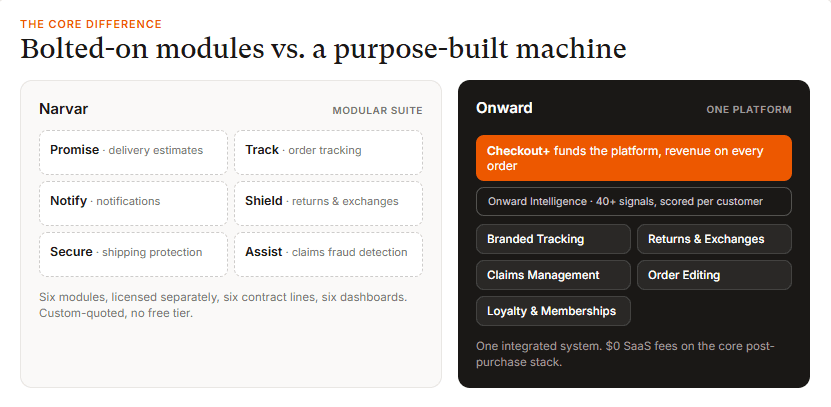
Narvar's model is modular software. There are six products: Promise for pre-purchase delivery estimates, Track for order tracking, Notify for notifications, Shield for returns and exchanges, Secure for shipping protection, and Assist for claims fraud detection. You license them à la carte. Each carries its own contract line, its own scope, and its own dashboard. The suite is broad and battle-tested at enterprise scale, and each piece is competent. The economics are those of a SaaS stack: pricing is custom and quoted, there is no free tier, and costs scale with your volume. The value it produces is operational efficiency.
That breadth is not the product of a single design. It is the product of thirteen years of accretion: a tracking tool that came first, then a returns tool, then notifications, then protection, then fraud detection, each added as its own module. It is a cobbled-together assemblage of parts, not a purpose-built machine. Nothing in the suite is architected to make the other pieces perform better.
Onward started from a different question: what should the post-purchase experience do for a brand when nothing goes wrong? The answer became Checkout+, an order upgrade that bundles order protection, CashBack rewards, a 90-day satisfaction guarantee, coverage across twice the claim types of standard competitors, optional free returns, carbon-neutral shipping, and sponsored charitable donations into a single opt-in.
Behind Checkout+ sits Onward Intelligence, a real-time agentic scoring system analyzing 40-plus customer behaviors. Alongside it sits the full platform: Returns and Exchanges, Branded Order Tracking, Order Editing, Claims Management, and, following the acquisition of Inveterate, Loyalty and Paid Membership programs. All at zero SaaS fees.
Narvar makes post-purchase operations work. Onward makes post-purchase generate lifetime value. Each is a legitimate way to run the function, and the two simply answer to different scoreboards.
What Narvar Delivers
Pedigree is a strength. Narvar has been doing this longer than almost anyone, and it shows in the customer roster: Sephora, Levi's, Gap, Lululemon, Puma, Sonos, and Dyson all run on it. For a large enterprise that wants a vendor with a long track record and proven reliability at very high volume, that history carries weight.
The tracking product is mature. Branded tracking pages, delivery-status personalization, embedded tracking modules, and post-purchase product recommendations are all well-developed, and Narvar credits Track with a 50% reduction in call-center costs and 3.2x tracking-page visits per order. Promise, its pre-purchase delivery-estimate product, is a capability many competitors do not offer at all. And Notify is deep on communication channels, spanning email, SMS, WhatsApp, and push across 50-plus event types.
The returns product, Shield, is capable on paper: automated labels, eligibility rules, incentivized exchanges, store credit, and an IRIS-powered fraud layer, with Narvar claiming up to 60% of return value retained through exchanges and store credit. In practice, it is the piece of the suite that draws the most criticism. Third-party reviews describe onboarding as slow and developer-heavy (one implementation reportedly ran close to two years), an interface that is inflexible for merchant self-service, a return portal that historically handled one item at a time, and support that is inconsistent once you are live. It is a serviceable returns tool that does not stand out.
Breadth is the other thing Narvar sells. Delivery estimates, tracking, notifications, returns, protection, and fraud detection all come from one vendor. For a brand that wants a single procurement relationship across a lot of surfaces, there is convenience in that.
But convenience at the point of purchase is not the same as leverage in the product. Each module is licensed and run on its own, with its own contract and its own dashboard, and owning a lot of surfaces does not make them reinforce one another. Nothing in the suite is designed to lift the numbers on anything else in it.
There is a second limit worth naming: every one of those modules is an operations tool. Not one of them puts revenue on the order. There is no CashBack mechanism, no customer-level intelligence layer that changes what an individual shopper is offered, and no loyalty or paid membership structure anywhere in the lineup.
What Onward's Platform Delivers
Checkout+ and CashBack Rewards
Checkout+ bundles order protection, CashBack credits, a 90-day satisfaction guarantee, optional free returns, carbon-neutral shipping, and sponsored donations into a single opt-in. Customers see value at the point of purchase on any order, whether or not anything ever goes wrong.
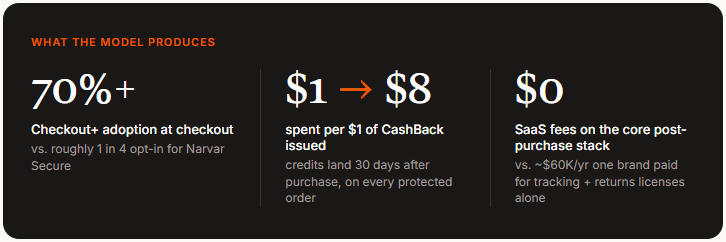
This directly drives adoption. Protection products that only pay out when something goes wrong give customers limited incentive to opt in on repeat purchases. Checkout+ delivers value on every order. Adoption rates land at 70% and above, compared to the roughly one-in-four opt-in rate Narvar reports for its Secure protection product.
CashBack credits are issued 30 days after purchase on every protected order, regardless of whether anything goes wrong. Onward sponsors a portion. For every $1 in CashBack issued, customers spend $8 on average.
Narvar has store credit incentives inside its Shield returns product, but that credit only appears once a return is already underway. There is no mechanism anywhere in the Narvar suite that puts credit in a customer's account for a purchase that shipped and arrived exactly as expected.
Onward Intelligence
Onward Intelligence is the connective tissue across the platform: a real-time scoring system analyzing spend history, lifetime value, return patterns, and 40-plus other signals. Trusted customers get faster approvals, automatic credits for shipping delays, and double CashBack. Customers exhibiting abusive patterns get appropriate friction that protects margins.
Narvar's IRIS is a large data engine (the company cites 74 billion annual interactions), and it powers fraud detection in Shield and Assist along with reporting across the suite. But that is aggregate analytics and rule-based fraud prevention. It tells you what is happening across your order base and flags risky returns. It does not score an individual customer in real time and change what that specific customer is offered at their next post-purchase moment.
The distinction matters for CX leaders because Onward Intelligence is the layer that lets a CX team show impact in dollars, on top of the usual satisfaction scores.
Claims Resolution
Of everything on the comparison chart, this is the line that separates the two approaches most cleanly. It is also where Narvar looks most like the rest of the field.
Narvar Secure is administered by UPS Capital Insurance Agency and underwritten by an authorized insurance company, so claims run through the insurer, not through Narvar. It covers physical loss and damage in transit (lost, stolen, and damaged packages) and explicitly excludes delay and consequential loss. Coverage is capped at $2,000 per shipment, requires a US-based business entity, and is governed by the insurance policy's terms and exclusions. When a claim is approved, proceeds are remitted to the merchant as loss payee, or to Narvar as the channel partner, who then pays you. Narvar targets resolution in "days, not weeks" through a self-service portal.
That model works, but it introduces an insurer between your customer and their resolution, and it puts the merchant in the middle of the money movement. It is worth noting that this is the same UPS Capital / InsureShield apparatus that powers AfterShip's protection product. Two of the biggest names in post-purchase outsource the same core function to the same third party.
Onward covers lost, stolen, damaged, and return-to-sender, plus wrong items shipped, missing items, post-delivery damage, product quality issues (including taste guarantees for consumables and satisfaction guarantees on apparel), and chargeback reimbursement. That is roughly twice the claim types. Resolution targets under one hour through an automated self-serve flow, handled in-house, with fraud detection powered by the same intelligence layer that scores customers.
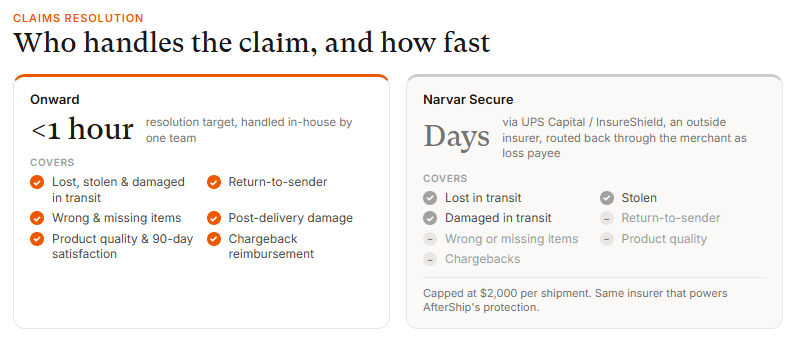
The difference a customer experiences: days and an insurance claim versus an hour and a resolution.
One Platform at Zero SaaS Fees
Onward's platform includes Checkout+, Returns and Exchanges (with no free returns requirement), Branded Order Tracking, Order Editing, and Claims Management. Zero monthly SaaS fees, across all of it.
Narvar Secure, like most protection products, carries no monthly fee for the merchant. The shopper pays, and the retailer can even earn a share of the premium. The rest of the suite is licensed software. Narvar does not publish pricing; every deal is custom and quoted through sales, and there is no free tier. Third-party estimates put small and mid-market quotes in the low thousands of dollars per month, and large, high-volume retailers in the tens of thousands per month, before you add modules. Track and Shield are the two most brands start with, and they are billed separately.
That is where the cost conversation happens, and the numbers are substantial. The Commerce Group runs five brands and roughly 400,000 orders a year on Shopify. Before moving to Onward, they were paying about $60,000 annually for two modules: roughly $50,000 for order tracking and $12,000 for returns. Tracking plus returns is exactly the two-module starting point a Narvar deployment is built around, and that figure does not include protection, notifications, delivery estimates, or fraud detection sold alongside it.
Onward has none of these line items. No custom-quoted module licenses, no per-module contracts, no separate returns and tracking bills, no annual renewal negotiation on a growing software spend.
Loyalty and Paid Memberships
The acquisition of Inveterate extends Onward into loyalty programs, paid memberships, spend-based tiers, and VIP programs, all powered by CashBack.
CashBack rewards from Checkout+ and loyalty balances from membership programs work as a unified system, giving merchants a single platform spanning from the checkout moment through repeat purchase and long-term LTV growth.
Narvar talks about loyalty as an outcome of a good post-purchase experience, but it does not sell a loyalty or paid membership product. The closest adjacent offering is store credit configured inside Shield. Nothing in the suite builds a tiered membership program or a recurring revenue relationship with your best customers.
Adaptable Software and Direct Access
Narvar's platform is largely take-it-as-it-comes. Reviewers describe an interface that resists customization, rule logic that does not flex to a brand's edge cases, and changes that route through support tickets and developer time. When the standard configuration does not match how a brand operates, there is little recourse, and the brand is the one that has to bend. Some of that is structural. A vendor with a few hundred employees and a deep org chart moves at the speed of its own bureaucracy, and a request loses signal at every layer it passes through before it reaches anyone who can act on it.
Onward treats the engagement as an ongoing partnership. It runs shared Slack channels with the brands it works with, and because the team is small and AI-leveraged, there are not fifteen layers of org between a merchant's request and the engineer who can answer it. When something does not fit, the question of whether it can be built gets asked directly, and the product adapts to the brand. In a market where undifferentiated SaaS is losing ground to white-glove customization, that responsiveness is part of what a brand is buying.
Feature Comparison
What the Stack Actually Costs
It helps to put real numbers to this, because the line "both have a free protection product" hides where the money goes.
A brand assembling Narvar's post-purchase stack licenses Track and Shield at minimum, and typically adds Notify and Promise as it matures. Pricing is custom and quoted per module, with no published rates and no free tier, and it scales with volume. Independent estimates put enterprise deployments in the tens of thousands of dollars per month. At scale, that is a five- or six-figure annual contract that shows up as a fixed cost every year and gets renegotiated at every renewal.
The same brand on Onward licenses nothing. Checkout+, Returns, Tracking, Order Editing, Claims, and Loyalty carry no subscription. The platform is funded by the attach revenue Checkout+ generates, which means the post-purchase program adds to gross margin.
That changes the kind of conversation you have internally. There is no growing software line item to defend at renewal; the program earns its place through the revenue and repeat purchase it produces.
Which Platform Is Right for You?
Choose Onward if you want: Post-purchase measured in LTV and repeat purchase rather than ticket deflection. CashBack rewards driving 70%-plus adoption and an 8x return per dollar issued. Real-time, customer-level scoring through Onward Intelligence. Twice the claim coverage, including product quality and chargebacks. Claims managed end-to-end by one team and resolved in under an hour. A consolidated platform with no SaaS fees on the core post-purchase stack, no per-module contracts, and no renewal negotiation. A vendor nimble enough to adapt the product to your business, with direct access to the team through shared Slack channels.
Consider Narvar if you need: A long-tenured enterprise vendor with a deep brand roster and proven reliability at very high volume. Pre-purchase delivery-date estimates as a specific requirement. A broad set of notification channels including WhatsApp. Deep tracking-page configurability as a primary requirement. You are comfortable with a custom-quoted, modular SaaS cost structure, running a largely standardized product without much customization, and already have rewards and loyalty handled elsewhere in your stack.
Questions to Ask When Evaluating
Does the platform create value when nothing goes wrong? This is what ultimately governs adoption. A program that only pays out on a claim has a natural ceiling on opt-in, and pure operational tooling gives the customer nothing to notice on an order that simply arrives on time.
Who actually handles the claim? A platform that runs claims with its own team controls the timeline, the tone, and the fraud call. A platform that hands claims to an outside insurer controls none of it, and your CX team inherits the wait. Ask specifically whether protection is underwritten and adjusted by a third party like UPS Capital, and where the money lands when a claim is approved.
Is the platform integrated, or just bundled? A set of separately licensed modules gathered under one logo over a decade is not the same thing as a system whose parts strengthen each other. The test is simple: ask the vendor what one product measurably does for another.
What happens when the out-of-the-box setup doesn't fit your business? Some vendors can adapt the product to how you operate and put you in direct contact with the people who build it. Others hand you a configuration and a support queue, and if the standard setup does not work, the workaround is yours to find. Ask how customization requests are handled, and how many layers sit between you and the vendor's engineers.
What is the total number of claim types covered, and what is the cap? Lost, damaged, and stolen is the baseline, and Narvar caps its coverage at $2,000 per shipment. Coverage for wrong items, missing items, product quality, and chargebacks represents materially broader protection.
Is there a customer intelligence layer, or just rules and dashboards? A large aggregate data engine can report on your whole base and flag risky returns without ever acting on a single shopper. The capability that matters is real-time, per-customer scoring that changes what an individual is offered based on what they are worth to you.
What does the stack cost at three times your current volume? Custom-quoted per-module licenses with no published pricing scale differently than a platform with no subscription at all. Model it against that growth case, and get every module you will need into the quote.
Does the platform extend into loyalty and repeat purchase, or stop at the delivery? A program that goes quiet the moment the package lands has done nothing about the second order, which is where lifetime value is won or lost.
The Bottom Line
Narvar built the post-purchase category, and it still shows in the pedigree: the tracking product is mature, the brand roster is enormous, and the suite reaches almost every surface after checkout. For brands whose post-purchase requirement is logistical and who want a long-tenured enterprise vendor, Narvar covers it. What it does not do is make those pieces work on each other, and its protection and returns products are the least differentiated parts of the stack: protection outsourced to the same insurer as its biggest rival, and returns that reviewers consistently describe as slow to implement and inflexible to run.
Onward is answering a different question. Checkout+ as a true order upgrade, CashBack driving repeat purchase, Onward Intelligence personalizing by customer value, claims managed by one team and resolved in under an hour, and loyalty and memberships through Inveterate. It is one system pointed at a single objective, with no SaaS fees on the core stack. That is what lets it pay off on the quiet orders and the problem orders alike, and for the finance team as much as the operations team.
If the job is to run post-purchase operations well, Narvar is a capable, well-established suite. If the job is to build the machine that grows customer lifetime value from checkout through loyalty and repeat purchase, that is the outcome Onward was designed around.
Schedule a demo to see how Onward delivers measurable financial impact across the entire post-purchase experience.
Frequently Asked Questions
What is the difference between Onward and Narvar?
Narvar is a modular post-purchase software suite covering delivery estimates, tracking, notifications, returns, protection, and claims fraud detection, each licensed separately and priced through custom quotes with no free tier. Onward is a customer lifetime value platform that combines Checkout+, protection, returns, tracking, order editing, claims, and loyalty into a single integrated system, with no SaaS fees on the core post-purchase stack, funded by the attach revenue it generates, with no subscription.
Does Narvar offer CashBack or loyalty rewards?
No. Narvar offers store credit incentives inside its Shield returns product, but it does not issue rewards on every order and does not sell loyalty tiers or paid memberships. Onward issues CashBack on every protected order 30 days after purchase regardless of whether a claim is filed, driving an 8x return per dollar issued, and offers loyalty and paid membership programs through Inveterate.
Who handles claims for Narvar Secure?
Not Narvar. Narvar Secure is administered by UPS Capital Insurance Agency and underwritten by an authorized insurance company, the same UPS Capital / InsureShield apparatus that powers AfterShip's protection product. Approved claims are paid to the merchant as loss payee, or to Narvar as channel partner, who then pays you, and the process runs in days. Onward manages the entire program in-house: one team owns coverage, claim approval, fraud review, and customer communication, with a target resolution under one hour.
Which platform covers more claim types?
Onward covers roughly twice as many. Narvar Secure covers physical loss, damage, and theft in transit, capped at $2,000 per shipment. Onward covers those plus return-to-sender, wrong items, missing items, post-delivery damage, product quality issues, 90-day satisfaction guarantees, and chargeback reimbursement.
How much does Narvar cost compared to Onward?
Narvar's protection module, Secure, carries no monthly fee for the merchant, but the rest of the suite is subscription software licensed by module. Narvar does not publish pricing; every deal is custom-quoted, with no free tier. Independent estimates put small and mid-market quotes in the low thousands of dollars per month and enterprise deployments in the tens of thousands per month, before adding modules. For perspective, The Commerce Group was paying roughly $60,000 a year for order tracking and returns alone (the exact two-module starting point of a Narvar deployment) before switching to Onward. Onward charges no SaaS fees across its entire platform, with no per-module licenses or renewal negotiations.
What happens if Narvar's software doesn't fit my business?
Narvar's platform is largely standardized, and reviewers note that customization is limited and that changes often route through support tickets or developer time. If the out-of-the-box configuration does not match how a brand operates, there is not much room to adapt it. Onward works the other way around: it adapts the product to the brand, runs shared Slack channels for direct access, and keeps a short path between a merchant's request and the engineer who can act on it.
Which platform has real-time customer scoring?
Onward, through Onward Intelligence: a real-time agentic scoring system analyzing 40-plus customer behaviors to personalize post-purchase experiences by individual value. Trusted customers receive faster approvals, automatic delay credits, and double CashBack; abusive patterns receive appropriate friction. Narvar's IRIS engine processes a large volume of interactions for aggregate analytics and rule-based fraud prevention, but it does not score individual customers in real time to change what each one is offered.
Was Narvar first to market in post-purchase?
Yes. Narvar was founded in 2012 and is generally credited as the first entrant to the post-purchase category, pioneering branded order tracking. That tenure is a real strength in tracking and in enterprise credibility. The tradeoff is that the platform grew module by module over more than a decade into a suite of separately licensed products. It was never built as a single system around one outcome, and closing that gap is what Onward's LTV-first architecture is designed for.
Categories