
Seel is one of the better-known names in post-purchase protection. Founded in 2019 (originally Koverai), it now reports $6B in merchant GMV covered across 5,000-plus merchants. Its core products are Worry-Free Purchase, a return-assurance product that lets shoppers add return flexibility at checkout, and Worry-Free Delivery, a shipping-protection product. In 2026 Seel added an "agentic workforce" on top of that base: AI agents for support, resale, reviews, and marketing, sold per outcome.
Onward approaches the same problem from a different direction. It is a customer lifetime value platform built around Checkout+, an order upgrade customers opt into at checkout that generates revenue on every order. Protection, CashBack rewards, a 90-day satisfaction guarantee, tracking, returns, order editing, and claims management all in one stack at zero SaaS fees, funded by the revenue from upgraded orders Checkout+ creates rather than by a subscription.
The two overlap in obvious ways. Both cover shipping protection, both handle returns, and both frame post-purchase as a revenue opportunity. What sets them apart is what each platform is built on. Seel's foundation is risk: it makes returns and delivery worry-free by absorbing the cost itself, and turns tickets, resale, and reviews into revenue. Onward's foundation is an order upgrade that pays CashBack on every order. One monetizes the problem; the other enhances the relationship.
The Core Difference
Seel's model is protection plus automation. The base is coverage: Worry-Free Purchase (return assurance) and Worry-Free Delivery (shipping protection), each governed by the terms and limits of its plan. The shopper pays a small fee at checkout, Seel carries the risk and handles the resolution, and the merchant keeps 100% of the sale and pays nothing for the coverage. On top of that base, the 2026 agentic workforce adds a Support Agency, Sales Agent, Resale Agency, review and voice-of-customer agents, and a Marketing Agency, each priced per outcome.
Onward started from a different question: what should the post-purchase experience do for a brand when nothing goes wrong? The answer became Checkout+, an order upgrade that bundles order protection, CashBack rewards, a 90-day satisfaction guarantee, optional free returns, carbon-neutral shipping, and sponsored donations into a single opt-in. Behind it sits Onward Intelligence, a real-time scoring system analyzing 40-plus customer behaviors. Alongside it sits the full platform: Returns and Exchanges, Branded Order Tracking, Order Editing, Claims Management, and, following the Inveterate acquisition, Loyalty and Paid Memberships.
Both platforms have different use cases, and they produce very different numbers because they are anchored to different things. Seel's value concentrates on the orders where something is uncertain: a possible return, a lost package, an item sold past its return window. Onward's value lands on the quiet orders too.
What Seel Delivers
Seel's core product is somewhat unique in the marketplace. Worry-Free Purchase is return assurance: it lets a merchant offer returns on items that would otherwise be final sale, with Seel absorbing the cost and risk of that flexibility. For a brand selling final-sale, clearance, or high-return-rate inventory, that is a significant capability. Seel takes on that return risk directly.
Because Seel handles coverage itself rather than reselling someone else's, resolution runs through its own Resolution Center, which it reports accelerates 80% of shopper requests. Merchant reviews on the Shopify App Store are strong (4.9 stars across 267 reviews), and at $6B in covered GMV the operation is proven at scale. The 2026 agentic workforce extends it further, with agents that answer tickets, recommend products, power one-click resale of past-window items, and collect reviews, a credible attempt to turn returns, support, and risk into revenue.
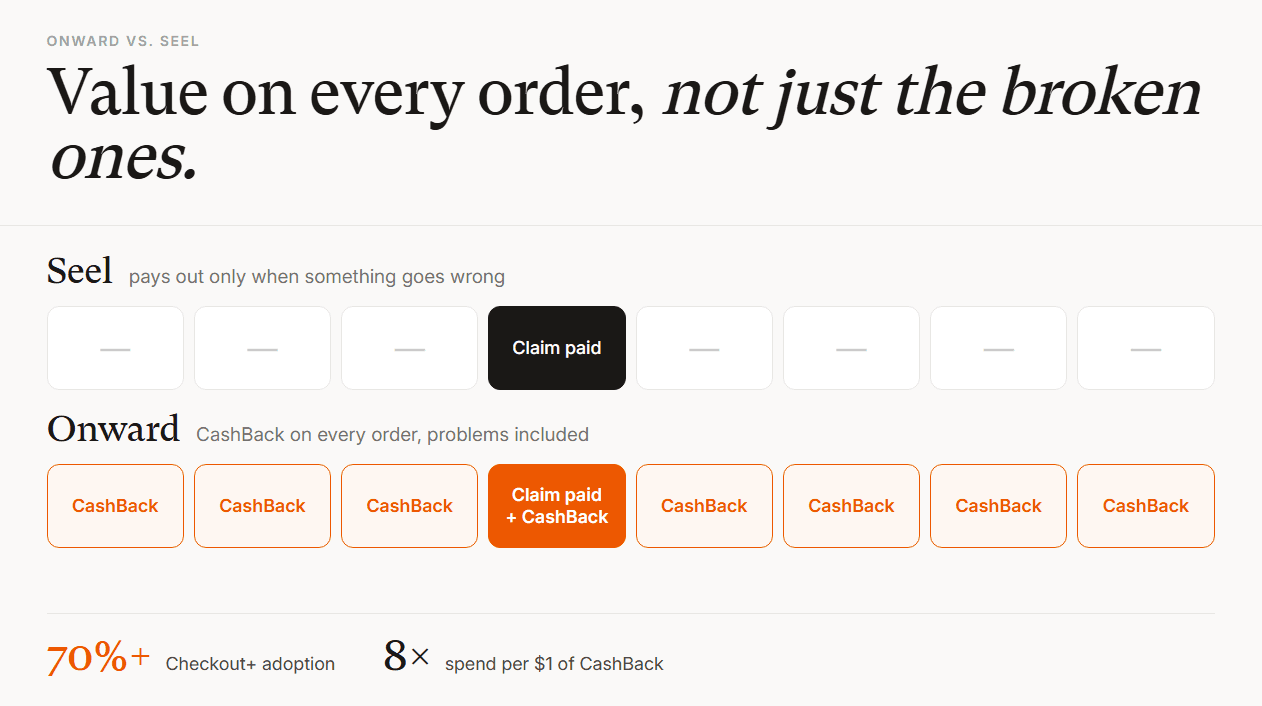
That foundation is not built to reward an ordinary order. Every Seel product is a risk product or an operations agent: Worry-Free Purchase pays out when a shopper returns, Worry-Free Delivery when a shipment fails, the agents earn when a ticket resolves or an item resells. None of it puts value in a customer's account for a purchase that shipped, arrived, and was kept as expected.
There is no CashBack, no customer-level scoring that changes what a shopper is offered, and no loyalty layer anywhere in the lineup. Value only lands when something goes wrong, so the checkout fee can read to a shopper as coverage they hope never to use. Seel is built to make the problem orders profitable, not to reward the ordinary ones.
What Onward's Platform Delivers
Checkout+ and CashBack Rewards
Checkout+ bundles order protection, CashBack credits, a 90-day satisfaction guarantee, optional free returns, carbon-neutral shipping, and sponsored donations into a single opt-in. Customers see genuine value at the point of purchase on any order, whether or not anything ever goes wrong.
This directly drives adoption and lifetime value. Protection products that only pay out when something goes wrong, give customers limited incentive to opt in on repeat purchases. Checkout+ delivers value on every order. Onward’s customer adoption rates average out at 70% and above, well beyond the opt-in rates typical of protection-only products.
CashBack credits are issued 30 days after purchase on every protected order, regardless of whether anything goes wrong. Onward sponsors a portion. For every $1 in CashBack issued, customers spend $8 on average.
Seel has store-credit and refund mechanics inside its return-assurance flow, and its Sales Agent can surface a recommendation, but neither is a reward issued on every order. There is no mechanism in the Seel platform that puts credit in a customer's account for a purchase that shipped and arrived exactly as expected.
Onward Intelligence
Onward Intelligence is the connective tissue across the platform: a real-time scoring system analyzing spend history, lifetime value, return patterns, and 40-plus other signals. Trusted customers get faster approvals, automatic credits for shipping delays, and double CashBack. Customers exhibiting abusive patterns get appropriate friction that protects margins.
Seel uses machine learning too, but the job it does is different. Seel's models price and improve its coverage over time, and its AI agents automate support, resale, and review collection. That is risk modeling plus operations automation. It tells Seel how to price an order's protection and lets agents run a workflow. It does not score an individual customer in real time and change what that specific shopper is offered at their next post-purchase moment based on what they are worth to the brand.
The distinction matters for CX leaders because Onward Intelligence is the layer that lets a CX team demonstrate impact in dollars, on top of the usual satisfaction scores.
Claims Resolution
Claims handling is one of Seel's real strengths. Unlike the big suites that outsource protection to a third party, Seel handles coverage and resolution directly through its own Resolution Center, so a shopper is not bounced to an outside claims desk, and resolution is fast and largely self-service. On its core perils, Seel does not hand a customer off to anyone.
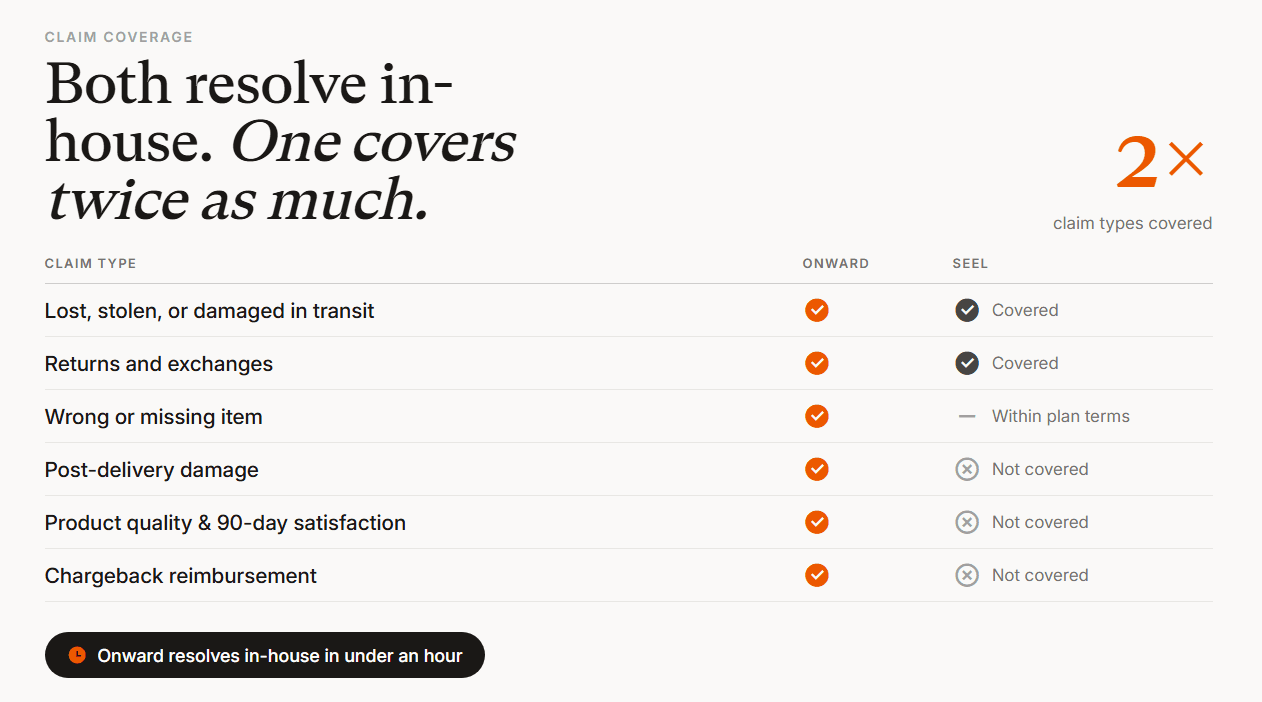
Where the two separate is breadth and scope. Seel's coverage protects the transaction, the return or the lost, damaged, or stolen shipment, within the terms and limits of its plan. Onward covers all of those plus return-to-sender, wrong and missing items, post-delivery damage, product quality (including taste and satisfaction guarantees), and chargeback reimbursement.
That is roughly twice the claim types, and several of them, product quality and satisfaction especially, sit outside what a shipping-and-returns protection plan typically covers. Onward resolves in-house under one hour, with fraud detection running through the same layer that scores customers, so a trusted customer's claim clears faster than a risky one's. The difference is less "who handles the claim" than "what counts as a claim."
One Platform, One Revenue Engine
Onward's platform includes Checkout+, Returns and Exchanges (with no free-returns requirement), Branded Order Tracking, Order Editing, and Claims Management, carried at zero monthly SaaS fees, and all of it funded by the same engine. Checkout+ generates the attach revenue that pays for the suite, and every component feeds the others: tracking and order editing keep customers in Onward's surfaces, returns and claims run through the intelligence layer, and CashBack turns each resolved moment into a reason to buy again.
Seel markets itself as one integrated system, and its core protection is well-integrated. But the breadth it now advertises, the support, sales, resale, review, and marketing agents, is a 2026 layer stacked on a protection business and sold à la carte per outcome.
What separates a bundle from a system is whether one product measurably improves another. With Onward, Checkout+ funds and powers everything else. Seel's newer agents are capable tools that mostly run their own workflows.
Loyalty and Paid Memberships
The acquisition of Inveterate extends Onward into loyalty programs, paid memberships, spend-based tiers, and VIP programs, all powered by CashBack rather than discounts alone.
CashBack rewards from Checkout+ and loyalty balances from membership programs work as a unified system, giving merchants a single platform spanning from the checkout moment through repeat purchase and long-term LTV growth.
Seel does not sell a loyalty or paid-membership product. Its closest adjacent motions are the Resale Agency and the Sales Agent, both of which are about extracting incremental revenue from a transaction, not building a recurring, tiered relationship with a brand's best customers. Nothing in the Seel lineup turns a repeat buyer into a member.
Adaptable Software and Direct Access
Onward treats the engagement as an ongoing partnership, running shared Slack channels with its brands and keeping few layers between a merchant's request and the engineer who can act on it. When something does not fit, the product adapts to the brand.
Seel operates at a larger, more standardized scale, and its core is a protection product governed by fixed coverage terms rather than by what any one merchant would prefer. That is not a knock on Seel's support, which merchants rate highly; it is a structural note. A protection plan flexes within its terms; a platform funded by attach revenue can reshape the product itself.
Feature Comparison
Capability | Onward | Seel |
Shipping Protection (lost, stolen, damaged) | Yes | Yes (Worry-Free Delivery) |
Branded Order Tracking | Yes | Global delivery tracking (protection-linked) |
Returns and Exchanges | Yes (no free-returns requirement) | Yes (Resolution Center) |
Order Editing | Yes | Not a standalone product |
Return-to-Sender Coverage | Yes | Within plan terms |
Wrong Item / Missing Item Coverage | Yes | Limited to plan scope |
Product Quality / Satisfaction Guarantee | Yes (90-day) | No (outside standard coverage) |
Chargeback Reimbursement | Yes | No |
Claims Management | Handled in-house by Onward | Handled in-house by Seel |
Claims Resolution Target | Under 1 hour | Fast; instant approvals for eligible cases |
CashBack Rewards on Every Order | Yes | No |
Customer Intelligence / Scoring | Yes (40+ signals, real-time, per customer) | Risk models + ops automation |
Loyalty and Paid Memberships | Yes (via Inveterate) | No |
Resale of Past-Window Items | No | Yes (Resale Agency, 1-click resale) |
AI Support / Marketing Agents | Onward Intelligence across the stack | Yes (per-outcome pricing) |
Carbon-Neutral Shipping | Yes (via Cool Effect) | No |
Merchant Cost, Core Protection | $0; funded by Checkout+ attach revenue | $0; customer-paid protection |
Merchant Cost, Broader Platform | $0 SaaS across the suite | Per-outcome fees on AI agents, resale, reviews |
Which Platform Is Right for You?
Choose Onward if you want:
Post-purchase measured in LTV and repeat purchase rather than deflected returns and tickets.
CashBack rewards driving 70%-plus adoption and an 8x return per dollar issued.
Real-time, customer-level scoring through Onward Intelligence.
Roughly twice the claim coverage, including product quality, satisfaction, and chargebacks that a standard protection plan excludes.
Claims managed end-to-end by one team and resolved in under an hour.
A consolidated platform, tracking, order editing, returns, claims, and loyalty, with no SaaS fees and no per-outcome metering.
A vendor nimble enough to adapt the product to your business, with direct access to the team through shared Slack channels.
Consider Seel if you need:
Return assurance as a specific requirement, especially the ability to offer returns on final-sale, clearance, or high-return-rate inventory with Seel carrying the risk.
Shipping protection handled and resolved in-house rather than outsourced.
A fast, self-service resolution flow, proven at scale.
An AI operations layer, support, resale, and review agents, that you are comfortable buying per outcome.
You already have rewards, loyalty, and lifetime-value programs handled elsewhere in your stack.
Questions to Ask When Evaluating
Is the foundation risk or reward? Return assurance and shipping protection only pay out when a shopper returns or a package fails, which caps how enthusiastically customers opt in on repeat orders. Ask what the customer receives on an order that simply arrives and is kept, and which orders the platform is designed to profit from.
Is the platform one system, or a base plus à-la-carte add-ons? Seel's core protection is well-integrated, but ask what its 2026 AI agents measurably do for one another and for the protection base, and how each is priced.
How many claim types are covered, and what is excluded? A protection plan covers the transaction within set terms. Ask specifically about product quality, satisfaction, and chargebacks, typically outside a shipping or return plan but inside an in-house program.
Is there a customer-intelligence layer, or risk models and ops automation? Pricing risk and automating tickets is not the same as scoring an individual customer in real time and changing what that shopper is offered based on lifetime value.
Does the platform extend into loyalty, or stop at the resolution? Reselling a past-window item or clearing a return recovers a transaction. It does not build a membership or a reason to come back. Ask where the second and third orders come from.
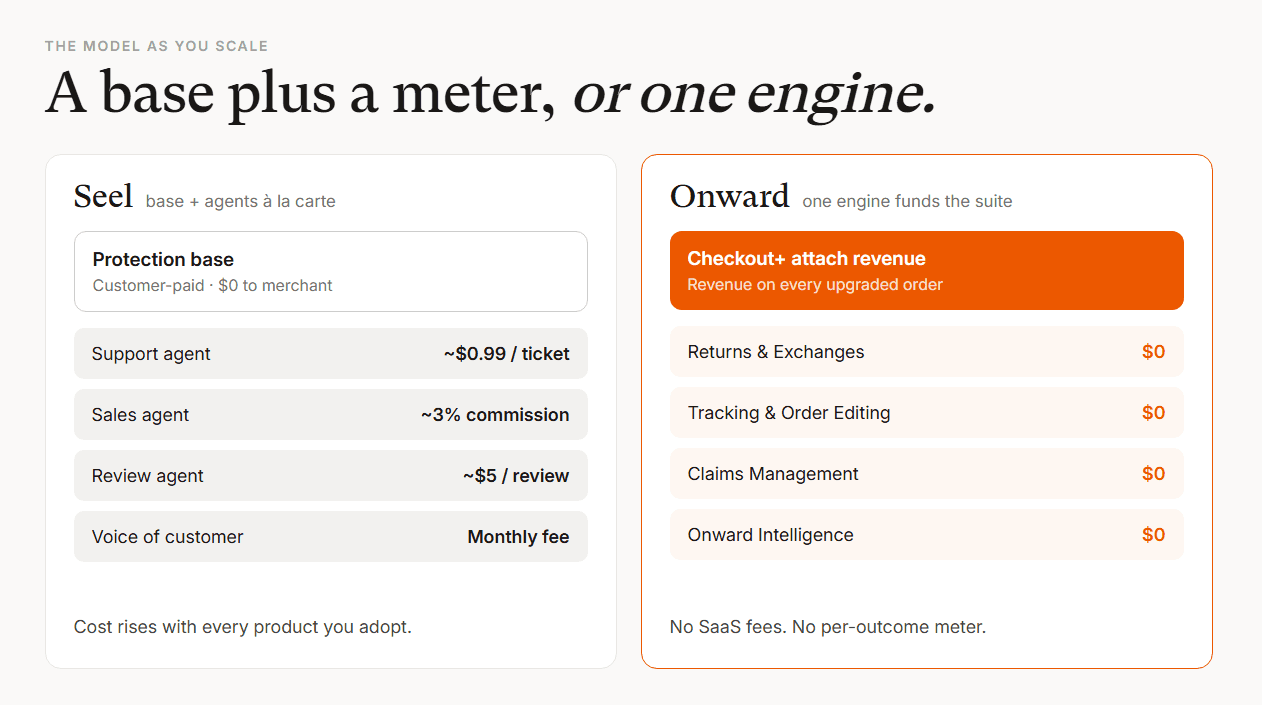
What does the model cost as you grow into it? Core protection is customer-paid on both sides, but ask what happens as you adopt more: per-outcome agent fees and sales commissions on one path, a funded loyalty and CashBack engine on the other.
The Bottom Line
Seel is a strong, modern post-purchase protection company. Its return assurance is unique, it handles and resolves claims in-house, merchants rate it highly, and its 2026 agentic layer is a credible push to turn returns and support into revenue. For a brand whose central need is to take the risk out of returns and delivery, it is a serious option, and the "pile of acquisitions" critique does not fit it.
But Seel is built on risk, and that defines what it can produce: value on the orders where something goes wrong, no CashBack, no per-customer scoring, and no loyalty layer.
Onward is answering a different question. Checkout+ as a true order upgrade, CashBack driving repeat purchase, Onward Intelligence personalizing by customer value, claims across roughly twice the claim types resolved in under an hour, and loyalty and memberships through Inveterate. One system, pointed at one objective, funded by the value it creates, with no SaaS fees and no per-outcome meter. That is what lets it pay off on the quiet orders and the problem orders alike, for the finance team as much as the operations team.
If the job is to make returns and delivery worry-free, Seel does that as well as anyone. If the job is to build the machine that grows customer lifetime value from checkout through loyalty and repeat purchase, that is the outcome Onward was designed around.
Schedule a demo to see how Onward delivers measurable financial impact across the entire post-purchase experience.
Frequently Asked Questions
What is the difference between Onward and Seel?
Seel is a post-purchase protection platform. Its core products, Worry-Free Purchase (return assurance) and Worry-Free Delivery (shipping protection), cover the transaction, and in 2026 it added an "agentic workforce" of per-outcome AI agents for support, resale, reviews, and marketing. Onward is a customer lifetime value platform that combines Checkout+, protection, returns, tracking, order editing, claims, and loyalty into one integrated system at zero SaaS fees, funded by Checkout+ attach revenue. Seel monetizes risk and its resolution; Onward monetizes the customer relationship through CashBack and repeat purchase.
Is Seel a "bolted-together" suite of acquisitions like the bigger post-purchase companies?
No. Seel grew organically from a protection product rather than by acquisition, and it markets itself as one integrated system, not a fragmented stack. The clearer distinction is foundational: Seel is built on absorbing return and shipping risk, with a 2026 AI-agent layer added on top and sold à la carte, while Onward is built on a single revenue engine, Checkout+ and CashBack, that funds and powers every other component.
Does Seel offer CashBack or loyalty rewards?
No. Seel offers refund and store-credit mechanics inside its return-assurance flow and can surface recommendations through its Sales Agent, but it does not issue a reward on every order and does not sell loyalty tiers or paid memberships. Onward issues CashBack on every protected order 30 days after purchase regardless of whether a claim is filed, driving an 8x return per dollar issued, and offers loyalty and paid-membership programs through Inveterate.
Who handles claims for Seel, and is protection outsourced?
Seel handles claims in-house. Unlike the large suites that outsource protection to a third party, Seel manages coverage and resolution directly through its own Resolution Center, which offers fast, largely self-service resolution. Onward also manages claims in-house, resolves in under an hour, and covers roughly twice the claim types, including product quality, satisfaction, and chargebacks that a standard protection plan typically excludes.
Which platform covers more claim types?
Onward covers roughly twice as many. Seel's coverage protects the transaction within its protection plan: returns for any reason on covered orders, and shipping perils such as loss, damage, and theft, subject to that plan's terms and limits. Onward covers those plus return-to-sender, wrong items, missing items, post-delivery damage, product quality issues, 90-day satisfaction guarantees, and chargeback reimbursement.
How much does Seel cost compared to Onward?
On core protection, both are effectively free to the merchant: Seel's protection is customer-paid and the merchant keeps 100% of the sale, while Onward's core stack carries no SaaS fees and is funded by Checkout+ attach revenue. The difference is where each monetizes as you grow. Seel's agentic layer charges per outcome, roughly $0.99 per resolved ticket, about a 3% commission on agent-driven sales, around $5 per positive review, and a monthly VoC fee, while Onward's growth surface is CashBack and loyalty, funded by the model itself with no per-outcome metering.
What is Worry-Free Purchase, and does Onward do the same thing?
Worry-Free Purchase is Seel's return-assurance product. Shoppers pay a small fee at checkout to add return flexibility, including on items that would otherwise be final sale, with Seel taking on the risk and covering the cost. It is a genuine strength, and Onward does not take on return risk as a provider the way Seel does. Onward instead includes returns and exchanges in its integrated suite at no SaaS fee and adds product-quality and satisfaction coverage a return-assurance product does not, but a brand whose specific need is guaranteed returns on final-sale inventory should weigh Worry-Free Purchase on its own merits.
Which platform has real-time customer scoring?
Onward, through Onward Intelligence: a real-time agentic scoring system analyzing 40-plus customer behaviors to personalize post-purchase experiences by individual value. Trusted customers receive faster approvals, automatic delay credits, and double CashBack; abusive patterns receive appropriate friction. Seel uses machine learning to price and improve its coverage and to run its AI operations agents, but that is risk modeling and workflow automation, not real-time scoring that changes what an individual customer is offered at their next post-purchase moment.
Categories