Onward vs. Route: Which Shipping Protection Solution Is Right for You
Route built impressive early-stage product, but the market evolved beyond basic shipping protection. Merchants have now discovered that basic protection, monthly SaaS fees, limited coverage scope, and slow support doesn't meet modern customer expectations or deliver the economics successful DTC brands require.
Onward rebuilt the model from first principles around upgraded order experiences that offer comprehensive coverage, genuine benefits (cashback, satisfaction guarantees), responsive service, and zero SaaS fees. Truly upgraded experiences deliver value whether packages arrive perfectly or encounter issues, responding to merchant needs in minutes, not days.
Check out the Onward difference for yourself.
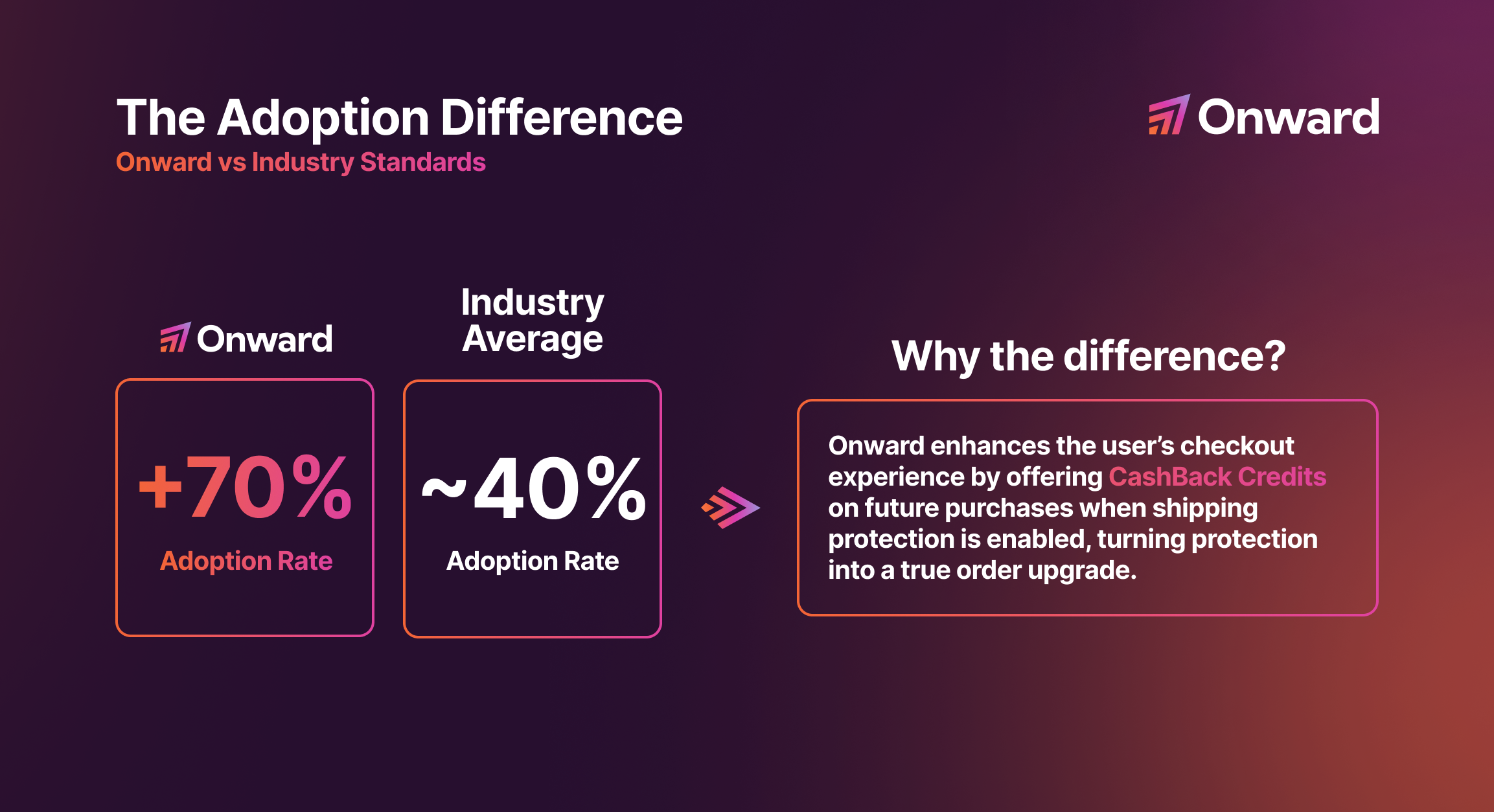
70%
Adoption Rate
8x
Cashback Redemption Ratio
+20%
LTV Increase
A Detailed Look
There's Basic Shipping Protection. Then There's an Upgraded Order Experience.
The difference? Route treats protection as a safeguard against unlikely problems. Onward treats it as an order upgrade customers actively want—driving 75% higher adoption while eliminating monthly fees and delivering instant support.
Brands switching from Route to Onward discover the difference:
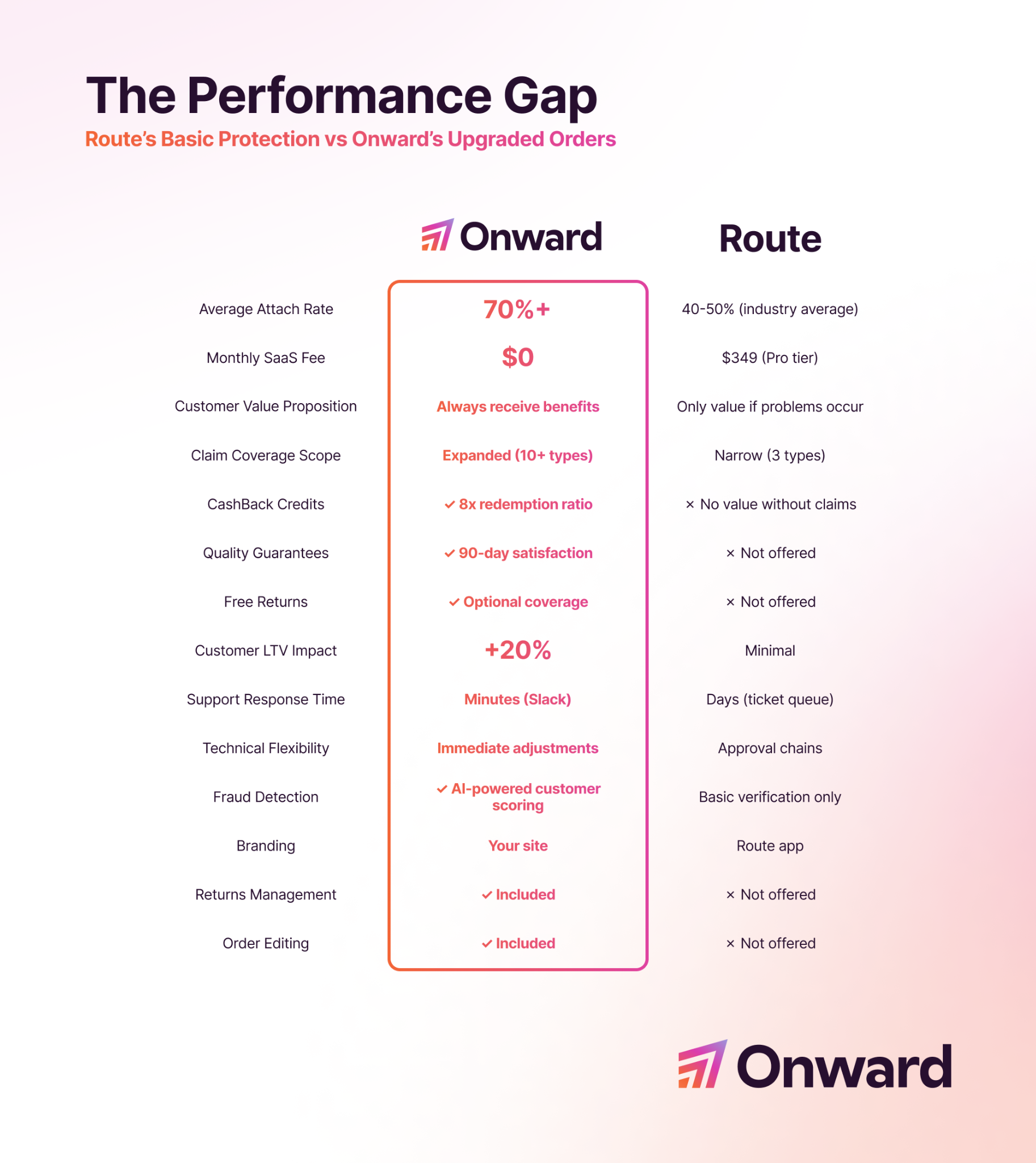
Route: Basic Protection Model
Industry average 40-50% adoption (customers see limited value)
Lost/stolen/damaged coverage only
Monthly SaaS fees for features standard with Onward ($349/month Pro tier)
Days-long ticket support
Zero benefits when packages arrive safely
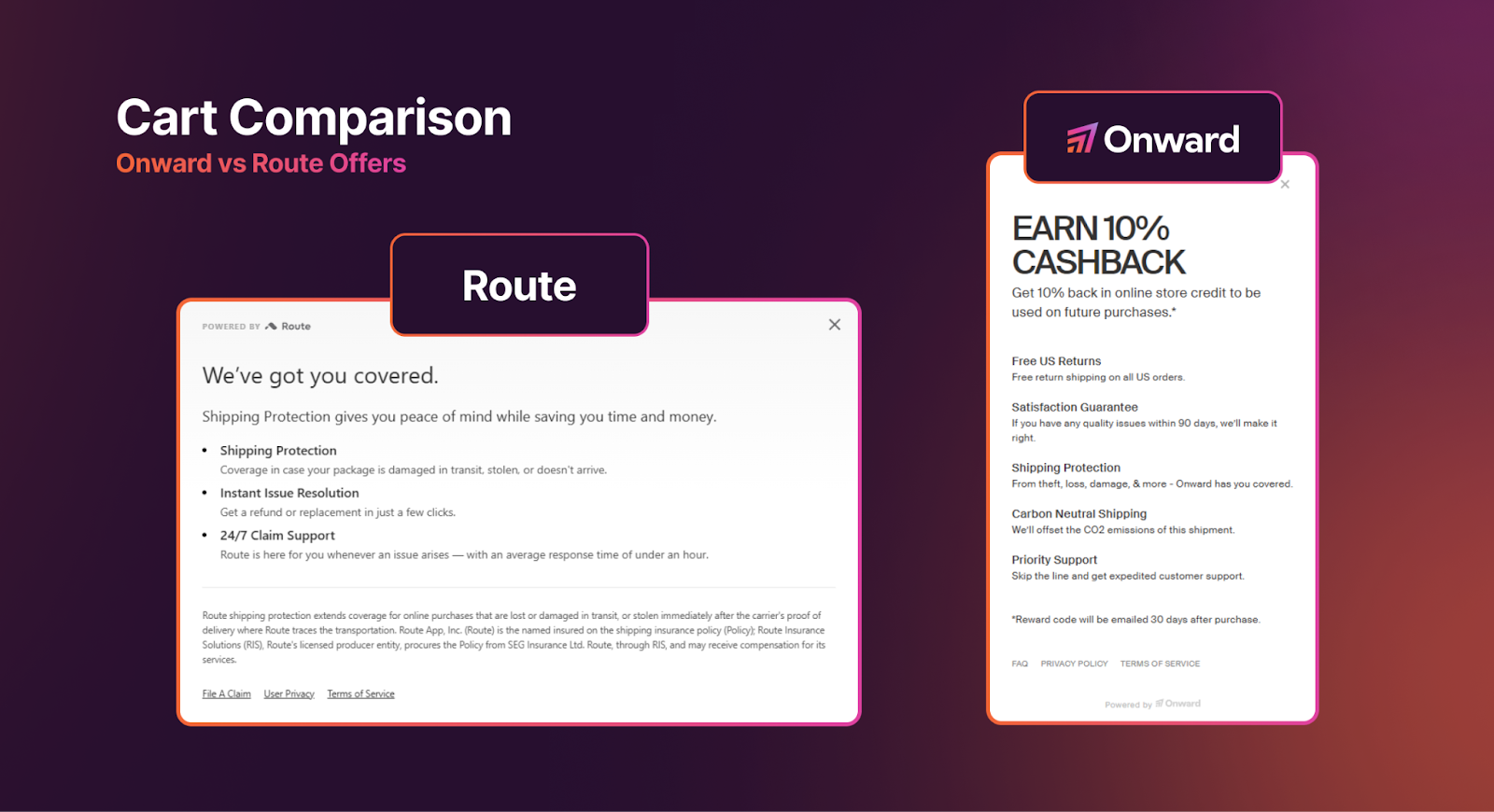
Route-branded experience pulling customers off your site
AI-powered fraud monitoring for faster approvals and reduced claim abuse
20% higher customer LTV through cashback credit
Fully branded experience on your domain
With an estimated 1.7 million packages lost or stolen daily in the US¹ and 1 in 4 Americans experiencing package theft², shipping protection matters. But the platform you choose determines whether you're selling protection customers reluctantly buy or delivering upgrades they genuinely want.
Why pay monthly fees for basic protection when upgraded order experiences drive better adoption, better economics, and better customer relationships?
What Route Built vs What Customers Actually Want
Route launched in 2019 as a consumer tracking app with protection as an add-on. Route maintained its narrow focus on pre-delivery issues while merchants discovered that basic shipping protection doesn't drive the adoption, service quality, or loyalty they need.
Route's basic protection approach:
Limited coverage: Only lost, stolen, damaged packages during transit
No value without claims: Only customers who experience issues benefit
Industry average 40-50% adoption because more value isn’t offered
Monthly SaaS fees: $349/month for Pro tier features (branded pages)
Slow response times: Ticket-based support taking days to resolve issues
Bureaucratic structure: CSMs need approval chains for simple requests
Third-party branded experience: Customers leave your site for Route's app
The fundamental problem: Route is slower, rigid, lacks key features, costs more, and doesn't include all the upgrades that Onward does.
Onward's Upgraded Order Experience Approach
Onward reimagined shipping protection around a simple principle: the customer should always get more value than what they pay in no matter what. Every order should receive an upgrade, whether packages arrive perfectly or encounter issues. When customers’ perceived value is higher than the cost, then adoption rates, conversion rates, and lifetime value go up. Protection becomes a genuine benefit rather than hedging against unlikely problems, and adoption rates climb.
The complete order upgrade:
Expanded Shipping Protection
97% claim approval rate
Average issue resolution time less than one hour
Lost, stolen, damaged (everything Route covers)
Wrong item shipped, missing items from order
Return to sender issues, post-delivery damage
Chargeback reimbursement
AI-powered fraud detection using third-party tools and pattern recognition to approve legitimate claims quickly while flagging suspicious activity
CashBack Credits (The Game-Changer)
Cashback credit awarded to customer based on percentage of purchase price
8x average redemption ratio (for every $1 in credits, customers spend $8)
Quality Guarantees
Money-back assurance on product quality
90-day satisfaction guarantee (consumables)
Free returns coverage (optional)
Carbon-neutral shipping on protected orders
Zero Monthly SaaS Fees
No fixed costs regardless of order volume
Performance-based model aligns incentives with merchant success
The result: Onward supercharges the previous basic shipping protection model by providing tangible customer value to every order. Adoption climbs to 70%+ because customers recognize genuine benefits. Monthly fees disappear. Comprehensive coverage protects more revenue. Improved loyalty drives 20% higher customer lifetime value.
You don't choose between adoption, pricing, service, and ROI. You get all of it.
Real Brand Math: 15,000 Monthly Orders
Using a typical brand example with 15,000 monthly orders, it is easy to see the difference.
Route's Basic Protection Performance:
6,000 protected orders (40% adoption at industry average)
$4,188 annual SaaS fees (Pro tier at $349/month)
Multi-day ticket response times
No loyalty benefit from unused protection
9,000 unprotected orders still need support when issues arise
Route-branded tracking experience
Onward's Upgraded Order Performance:
10,500 protected orders (70% adoption)
$0 annual SaaS fees
Minutes-based Slack response times
20% LTV increase from cashback credit redemption
8x redemption ratio on unused credits
Only 4,500 unprotected orders need support
Fully branded experience on your domain
Why Basic Protection that Route Offers Fails (And Why Onward’s Order Upgrade Approach Succeeds)
1. The Adoption Rate Problem
Route's basic protection:
Customer pays $3 for protection
Package arrives perfectly (vast majority of the time)
Result: 70%+ adoption because customers want the upgrade
Why this matters: When half of customers opt out of basic protection at industry averages, merchants leave massive revenue unprotected. Onward's 70%+ adoption means 75% more orders receive protection—protecting revenue, reducing support burden, and creating loyalty opportunities basic protection never captures.
2. The Coverage Scope Problem
Route's narrow coverage:
Lost during transit
Stolen from porch (with exceptions)
Damaged in shipping (carrier fault only)
Onward's comprehensive protection:
Everything Route covers, plus:
Wrong item shipped
Missing items from order
Return to sender issues
Post-delivery damage
Chargeback reimbursement
Product satisfaction guarantees (consumables)
Extended warranties (durable goods)
Result: 97% claim approval rate because coverage matches real scenarios
Real merchant impact: A fashion brand averaging 15,000 monthly orders sees 300-400 claims monthly. Comprehensive coverage means fewer claims fall through gaps, fewer denied claims that merchants must absorb, and customers trust that legitimate issues will be resolved.
3. The Claims Fraud Abuse Problem
Route's basic verification:
Manual review processes
Limited fraud detection capabilities
Reactive approach to suspicious claims
Same verification requirements for all customers regardless of history
Onward's AI-powered Approach:
Customer scoring system identifies trusted customers vs potential bad actors
Integration with third-party fraud detection tools (NoFraud, Yi authentication)
Network data across all Onward merchants identifies fraud rings and patterns
Trusted customers get instant approvals; suspicious claims get additional verification
Telegram fraud ring detection through behavioral fingerprinting
Proactive fraud prevention reduces claim abuse without creating friction for legitimate customers
Real merchant impact: A brand processing on average 10,000 monthly orders with 250 claims sees dramatically different experiences. Trusted repeat customers get same-day resolutions. First-time customers from high-risk regions might need ID verification. Known fraudsters from Onward's network data face immediate blocks. The system learns and adapts, protecting revenue without punishing good customers.
Fraud detection isn't about denying claims, it is about approving legitimate ones faster while protecting merchants from organized abuse. When a trusted customer files a claim, they shouldn't wait days for verification that a first-time customer from a fraud hotspot requires.
4. The Service Quality Problem
What merchants report about Route:
"Route doesn't respond quickly and cannot accommodate new product requests or technical adjustments. They can be slow and bureaucratic."
Route's support constraints:
Submit tickets through support portal
Wait in queue (typically days for response)
CSM needs approval chains for technical requests
Bureaucratic processes delay simple adjustments
New app installation impacting protection? Wait in line for technical review
Onward's service model:
Shared Slack channel with each merchant
Real-time responses (minutes, not days)
Direct access to team members who can solve problems immediately
No approval chains for standard requests
New app impacting integration? Immediate troubleshooting and resolution
Example scenario: Merchant installs new cart drawer app that conflicts with protection widget placement.
Onward: Message in Slack, get immediate guidance, resolve within hours
For brands managing complex tech stacks and rapid iteration cycles, the service difference isn't incremental—it's the difference between moving fast and waiting in queues.
5. The Customer Loyalty Problem
Route's missed opportunity:
Most protected orders have no shipping issues
Customers feel initial value from shipping protection
May not retain perception of value after successful delivery
Customers don’t have a direct incentive to visit again
Onward's Cashback Program:
Many orders have no shipping issues
Customers receive cashback credits automatically
Store credit incentives drives next purchase
8x redemption ratio: for every $1 in credits issued, customers spend $8
20% measurable increase in customer lifetime value
The mechanism: Onward provides the customer cashback 30 days after purchase via a unique promo code. Onward sponsors half of the cashback for the merchant ensuring a profitable future revenue opportunity. The customer cashback code works like a rolling credit balance that is deducted from or added to with future purchase activity.
Why Route Makes You Choose (And Why You Shouldn't Have To)
Choose Between Quality Service or Platform Consolidation
Route's limitations:
Shipping protection + tracking only
Need returns management? Another vendor
Need order editing? Another vendor
Days-long support responses
Result: Multiple vendor relationships, fragmented data, slow problem resolution
Onward's unified platform:
Shipping protection, returns management, order editing
Single vendor relationship
Unified reporting and data
Minutes-based Slack support
Cost: Still $0/month
Why settle? Platform consolidation shouldn't mean sacrificing service quality. You get complete post-purchase management with instant support and no additional vendors.
Choose Between Customer Value or Merchant Economics
Route's misalignment:
Customers pay for protection
Merchants pay $349/month (Pro tier with comparable features)
Half of customers opt out at industry averages (don't see value)
Merchants pay fees while majority reject the service
No loyalty benefit when protection goes unused
Onward's alignment:
Customers pay for protection
Merchants pay $0 monthly fees
70%+ opt in (customers want the upgrade)
Cashback credits drive loyalty regardless of claims
20% LTV increase benefits both customer and merchant
Why settle? Customer value and merchant economics should reinforce each other. Upgraded orders align incentives perfectly.
Platform Completeness: The Final Comparison
Route can't provide platform consolidation. They're a point solution maintaining relevance while merchants seek unified experiences.
Route's point solution:
Shipping protection
Package tracking
That's it
Onward's unified platform:
Shipping protection
Expanded coverage (10+ claim types)
CashBack program
Quality guarantees
Returns management
Order editing
AI fraud detection
Complete post-purchase solution
The difference: Onward is a modern SaaS company constantly iterating based on merchant feedback. Route operates like a mature company optimizing existing offerings rather than solving emerging merchant needs.
When Route Makes Sense
Route might work if you:
Are deeply integrated with Route's operations and switching costs outweigh 75% adoption improvement
Are satisfied with industry average 40-50% adoption rates and basic coverage scope
Don't require responsive technical support (multi-day ticket queues are acceptable)
Only need basic lost/stolen/damaged coverage without expanded protection scenarios
Don't value loyalty component or customer lifetime value improvements
Are comfortable with Route-branded experiences pulling customers off your site
For most mid-market brands prioritizing customer experience and unit economics, these trade-offs don't justify Route's limitations.
When Onward Makes Sense
Onward delivers superior results when you:
Refuse to choose between adoption and pricing (70%+ adoption + $0 SaaS fees vs industry average + $4,188 annually)
Want customers to receive value in every scenario of a shipping outcome (e.g., cashback credits for future purchases, satisfaction guarantees)
Need protection covering real scenarios (wrong items, missing items, post-delivery damage, not just lost/stolen/damaged)
Require instant support solving problems immediately (Slack-based real-time assistance vs days-long ticket queues)
Are consolidating post-purchase vendors (protection + returns + order editing in unified platform)
Want measurable ROI through higher LTV (20% improvement through loyalty banking)
Need technical flexibility for rapid integrations (no bureaucratic approval chains)
Want intelligent fraud prevention that approves legitimate claims quickly while protecting against organized abuse (AI-powered scoring vs. manual review)
Prefer complete brand ownership (customers stay on your domain throughout post-purchase journey)
Value continuous innovation (regular feature releases vs stagnant product)
The Bottom Line: Basic Protection vs. Upgraded Orders with Real ROI
Route built impressive early-stage infrastructure achieving unicorn status, but the market evolved beyond basic shipping protection. Merchants discovered that basic protection with industry average 40-50% adoption, monthly SaaS fees, limited coverage scope, and slow support doesn't meet modern customer expectations or deliver the economics successful DTC brands require.
Onward rebuilt from first principles around upgraded order experiences: make protection so valuable through comprehensive coverage, genuine benefits (cashback, satisfaction guarantees), responsive service, and zero SaaS fees that 70%+ of customers actively want it. Deliver value whether packages arrive perfectly or encounter issues. Respond to merchant needs in minutes, not days. Build toward complete post-purchase consolidation while aligning pricing with merchant success.
The choice:
Route: Basic Protection Model
Industry average 40-50% adoption (customers don't see value)
$349/month Pro tier fees
Narrow coverage (3 claim types)
Days-long ticket support
No value when packages arrive safely
Route-branded experience
Point solution
Onward: Upgraded Order Experience
70%+ adoption (customers want the upgrade)
$0 monthly SaaS fees
Comprehensive coverage (10+ claim types)
AI-powered fraud detection for instant legitimate approvals
Unified platform (protection + returns + order editing)
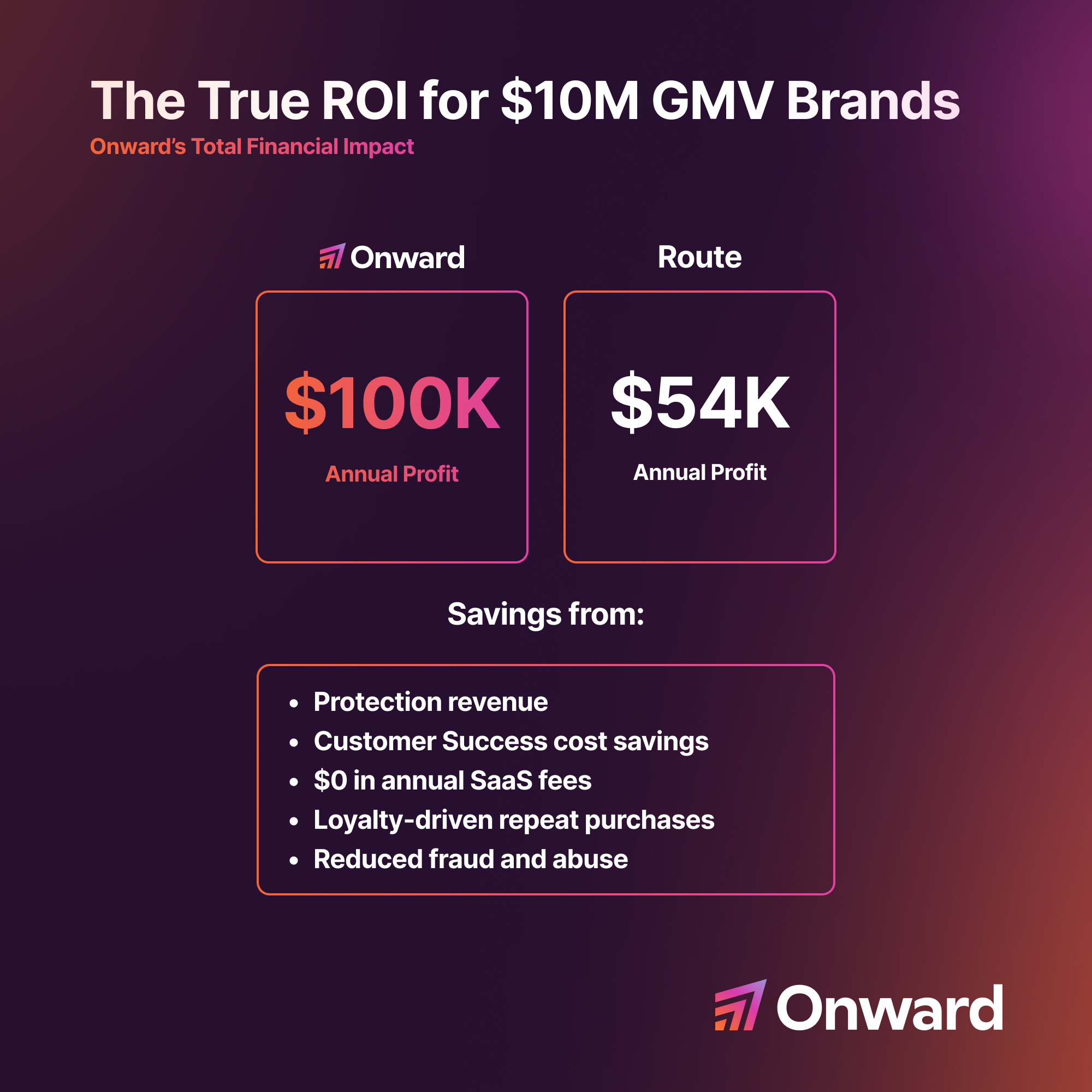
Real ROI: Onward doubles the financial impact of basic protection platforms while eliminating SaaS fees. The SaaS savings are just a bonus on top of 2x the profit. For every $10M in GMV, Onward typically delivers $100K+ in annual profit.
Your shipping protection platform touches most customers at their most critical moment—when they're anxious about whether their purchase will arrive safely and what happens if it doesn't.
Choose basic protection that half your customers reject, or choose upgraded order experiences that 70%+ actively want.
Choose $4,188 annual SaaS fees with narrow coverage, or choose zero fees with comprehensive protection.
Choose days-long ticket queues, or choose instant Slack support.
Choose protection that only pays when things go wrong, or choose upgrades that deliver value regardless of outcome.
Why pay more for basic protection when upgraded order experiences cost nothing and deliver everything?
Frequently Asked Questions
Is Route better than Onward for shipping protection?
Onward delivers 70%+ adoption rates compared to Route's industry-average 40-50%, charges zero monthly SaaS fees versus Route's $349/month Pro tier, and provides comprehensive coverage for 10+ claim types rather than Route's basic lost/stolen/damaged protection. Route makes sense if you're already deeply integrated and switching costs outweigh the 75% adoption improvement, but most mid-market brands achieve better economics and customer experience with Onward's upgraded order approach.
What's the main difference between Route and Onward shipping protection?
Route offers basic shipping protection (lost/stolen/damaged only). Onward provides upgraded order experiences where customers receive CashBack credits, 90-day satisfaction guarantees, and comprehensive protection regardless of delivery outcome, driving 70%+ adoption. Route charges $349/month for Pro tier features; Onward charges $0/month while delivering protection, returns management, and order editing in a unified platform.
Does Onward or Route have better customer support for merchants?
Onward provides dedicated Slack channels with minutes-based response times and direct access to team members who resolve issues immediately without approval chains. Route uses ticket-based support with typical multi-day response times and bureaucratic processes where CSMs need approval for technical adjustments. When a new app installation conflicts with protection widgets, Onward troubleshoots within hours via Slack; Route requires ticket submission and 3-5 day coordination with technical teams.
What happens to my Route data if I switch to Onward?
Onward handles complete migration including historical protection data, claims records, and customer information. The transition typically completes within 5-7 business days with white-glove onboarding where Onward's team manages technical implementation. Your existing Route customers can immediately start receiving Onward's upgraded order benefits (CashBack credits, expanded protection, satisfaction guarantees) while maintaining continuity in protection coverage. Onward's Slack-based support ensures rapid resolution of any migration issues.
How does Onward's CashBack program work compared to Route?
Route provides no loyalty benefit when packages arrive safely (which represents the vast majority of orders). Onward automatically awards CashBack credits 30 days post-purchase, typically 5-10% of order value, which customers redeem on future purchases. The 8x redemption ratio (customers spend $8 for every $1 in credits) drives 20% higher customer lifetime value while giving customers tangible value regardless of shipping outcome. Route customers who never file claims receive zero benefit; Onward customers always benefit through store credits.
What's Onward's fraud detection like compared to Route?
Onward uses AI-powered customer scoring that integrates with third-party fraud detection tools and network data across all Onward merchants to identify fraud rings and patterns. Trusted repeat customers receive instant claim approvals; suspicious first-time customers from high-risk regions get additional verification. Route uses basic manual review processes without intelligent differentiation. Onward's approach approves legitimate claims faster (97% approval rate with minutes-based resolution) while protecting merchants from organized abuse that Route's reactive system misses.
Can Onward replace my returns management platform like Loop or Redo?
Yes. Onward provides integrated returns management alongside shipping protection and order editing in a unified platform at $0/month. Loop and Redo charge separate fees and require brands to offer free returns to access their software. Onward gives merchants flexibility to offer free returns optionally rather than mandating them (free returns typically increase return rates, impacting profitability). Route only provides shipping protection and tracking, requiring separate vendors for returns management, creating fragmented data and multiple vendor relationships.
What ROI should I expect switching from Route to Onward?
Typical mid-market brands ($10M GMV) see $100K+ annual profit improvement through protection revenue from 75% higher adoption (70% vs 40%), reduced fulfillment costs from comprehensive claim coverage, loyalty-driven repeat purchases from CashBack credits (20% LTV increase), and eliminated SaaS fees ($4,188/year savings). Route's narrow coverage and industry-average adoption leave significant revenue unprotected; Onward's upgraded order approach converts shipping protection from cost center to profit driver while improving customer experience and lifetime value.
How long does it take to switch from Route to Onward?
Onward's white-glove onboarding typically completes within 5-7 business days including Route migration, technical implementation, and team training. Onward handles all technical details (unlike Route's setup requirements), requires only one onboarding call to go live, and provides dedicated Slack channel for immediate support during transition. Most merchants see higher adoption rates within the first week as customers respond to Onward's upgraded order experience (CashBack credits, expanded protection, satisfaction guarantees) compared to Route's basic protection offering.
What makes Onward's 70% adoption rate so much higher than Route's 40-50%?
Customers perceive Onward protection as an order upgrade rather than a safeguard because they receive tangible benefits regardless of shipping outcome: CashBack credits (typically $5-10 per order), 90-day satisfaction guarantees, optional free returns, comprehensive protection covering 10+ claim types, and carbon-neutral shipping. Route only delivers value when shipping problems occur (representing small percentage of orders), offering customers no benefit for successful deliveries. When perceived value exceeds cost, adoption climbs; when value only materializes during rare problems, adoption stalls at industry averages.